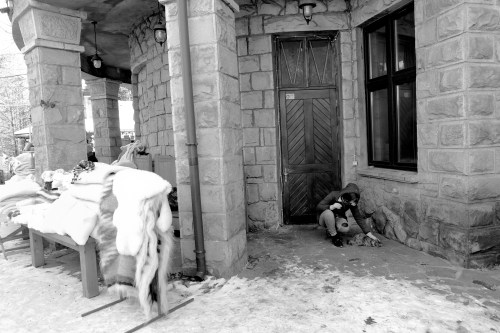
• Poem for the Camp

    Three flags whip and crack 

    over the Ledge like Canada Day celebrations 

    or hangfire warning shots


    It’s Deano’s 52nd 

    we go to McDonalds after an hour 

    deliberating where he wouldn’t get kicked out, if alone. We talk 

    about Willie Nelson. He eats a BigMac, 

    I finish his fries.


    I used to come to the Ledge to rev the engine at rabbits 

    padding along the asphalt

    at cyclists

    at things I didn’t really get


    Deano and I talk 

    about finding bikes in dumpsters. Later, alone, 

    I stop at a grocery store alley

    find an unopened pizza and wonder 

    which of these dumpsters he might’ve been sleeping in 

    the moment the trash was picked up

    and the compactor closed.


    One time with a girl

    through a crack in the stairs 

    I saw someone move in the Legislative basement 

    like a dungeon 

    keeper of secrets I had yet to learn

    bigger than a limestone building


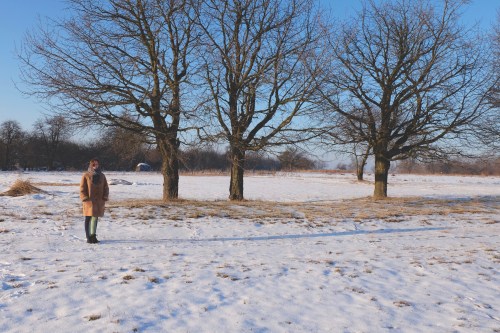
    I sit in the cold, consider

    what it would feel like to have my body valued 

    like expired frozen pizza

    or my blood used 

    to restore the big copper dome. 


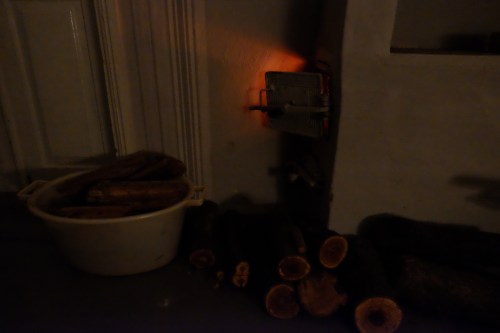
    Toes and head numb, I add more wood to the illegal sacred fire 

    and think about Willie Nelson.


    -Regina SK, March 16, 2018

    (Justice for Our Stolen Children Camp, Treaty 4)

    This poem was first published in Tour Book #2.


  • The Payphone

    The following excerpt is from the story The Payphone, first published online at Lunch Ticket, and now available as an audiobook and in print at BallsOfRice.Bandcamp.com. Artwork by Alex Murray.


    A man wearing a navy paisley bandana and wire-frame glasses pedaled his bike to the corner, stepped over his seat, and coasted on one foot to the bike rack at the side of the liquor store. He slotted his front wheel in the rack, strode four steps over to the unsheltered public payphone, lifted the handset, inserted a quarter, dialed the number to his daughter on the east end of town, and waited. He needed to call her Tuesday, today, to see if his cheque had arrived. His watch said 4:42 p.m.

    No dial tone started, nothing, until he heard an automated woman’s voice say in her cold, impersonal way, “Credit twenty-five cents. Please deposit twenty-five cents.”

    The man forgot that the phone company raised the price by one-hundred percent, to fifty cents. He patted his pants pockets, checked his jacket, checked the sidewalk, even checked the pouch attached to his bicycle, and couldn’t find a quarter. He couldn’t find two dimes and a nickel. He couldn’t find anything. There was no one around for several blocks to ask for change.

    “Fuck sakes!” the man cursed. He slammed the phone against the liquor store’s brick wall, breaking the earpiece off. He dropped the receiver and biked away.

    Finish the story at Lunch Ticket.

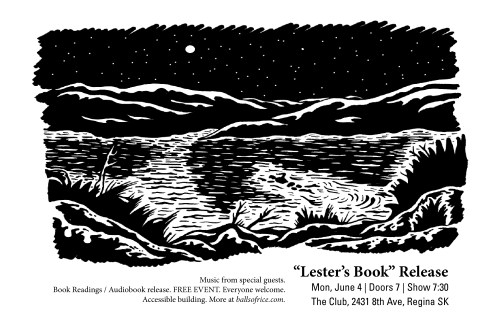
  • “Lester’s Book” Release Party


    I haven’t written through the Balls of Rice channel very much in the past two years as I’ve been working on other writing projects. These projects have included some of those listed under the Books and Audiobooks tabs of BallsofRice.com, smaller articles and book reviews, and more. If you’re able or interested, please come out to the “Lester’s Book” Release Party on June 4, or order a book from ballsofrice.bandcamp.com to see what I’ve been up to. I feel confident that this is some of my best work to date.

    Thanks for checking in.

    Facebook event here.

    [Art by Alex Murray (atmmurray[at]gmail.com)]

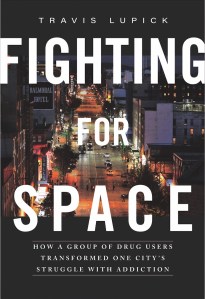
  • Fighting For Space

    The following book review of Travis Lupick‘s book Fighting For Space first appeared in Briarpatch Magazine‘s Prairie Edition, and online.

    In 2002, a group of residents and advocates met at the intersection of Main and Hastings in Vancouver holding a 100-foot-long hypodermic needle made out of a giant cardboard tube, stopping traffic. They were protesting the forced closing of a needle exchange on the corner of Main and Hastings in the Downtown Eastside. Earlier, in 2001, front-line workers had distributed clean needles in a trailer outfitted with washrooms, and ensured those using in bathroom stalls didn’t overdose. Affectionately known as “the Thunder Box,” the trailer became one of North America’s first unsanctioned supervised injection sites.

    These stories are among countless actions detailed in Travis Lupick’s Fighting for Space, which tells of the struggle that led to the implementation of Canada’s first official safe-injection site in Vancouver in 2003. The history of the harm reduction movement is one of direct action and protest – an “act first, ask second” attitude that was the only reasonable response to an outbreak of preventable disease and a crisis of premature deaths. Lupick focuses on the Portland Hotel Society (PHS), the groundbreaking housing non-profit that offered low-barrier housing to the city’s most vulnerable, and the Vancouver Area Network of Drug Users (VANDU), the advocacy group that pushed for accessible health care and decriminalization of drug use. The two worked in tandem, with VANDU often willingly taking the heat for direct actions to protect the more diplomatic and funding-restricted Portland Hotel Society.

    The history of the harm reduction movement is one of direct action and protest – an “act first, ask second” attitude.

    The 1990s saw a dramatic spike in overdose deaths and high rates of HIV diagnoses in Vancouver – not unlike the current fentanyl crisis playing out across Canada. But this time the human cost is much higher, with 2017 being the deadliest year on record for overdose deaths in B.C. The strategies used by advocates on the West Coast, honed over decades of persistent work, can provide guidance for similar struggles being newly waged in neighbouring Prairie provinces like Saskatchewan, where fentanyl has killed over 40 people since 2015.

    While revealing the staggering numbers of diagnoses and deaths is key to understanding the scope of the problem, it is the stories of the people who’ve lived through the harm reduction movement that makes this history real. By telling the accounts of people struggling for dignity against politicians and a public determined to dehumanize them, Lupick reinforces two basic claims of the harm reduction movement: people who use drugs are human, and all people deserve safety and health.

    In one of their first organized meetings, members of the newly formed VANDU agreed that they wanted somewhere safe and healthy to spend time, a space that was free of police harassment. The Portland Hotel Society’s first residence was known as the “Hotel of Last Resort.” Simplifying their message to one of “health and safety” – one that politicians and the public couldn’t reasonably reject – has grounded all of their actions and successes in the harm reduction movement. Lupick concludes the book with an epilogue about a family — Mary, Molly, and Mikel — in a quietly triumphant story of three generations living in the Portland Hotel Society, all experiencing stability in their health and housing.

    Lupick reinforces two basic claims of the harm reduction movement: people who use drugs are human, and all people deserve safety and health.

    Lupick does not deify Vancouver’s advocates or their process – rather, he shows them to be people offering the simple necessities of safety and support, while working toward inclusive public health policy. He demonstrates a proven way to effectively build low-barrier health care and housing systems: through persistent action coupled with advocacy, and building partnerships with sympathetic policy-makers. Without this infrastructure, the number of overdose deaths in B.C. last year would have been much higher.

    The current situation on the Prairies is nearly as dire as the one Vancouver faced in the 1990s. Saskatchewan’s HIVAIDS rates are the highest in the country, and with 79 per cent of the people newly diagnosed as HIV-positive self-identifying as Indigenous, programming must prioritize consultation with Indigenous communities. Meanwhile, harm reduction programs have been heavily stigmatized by a predominantly conservative public and openly scrutinized by political leaders. In 2009, former premier Brad Wall said his government would limit the number of clean needles handed out, despite a Saskatchewan Ministry of Health report proving the success of needle exchange programs. In 2017, The Sask. Party threatened community based organizations with a 10 per cent funding cut that would hit operations deemed not to be “core services,” like needle exchanges. Though the party eventually opted against the funding cut, when harm reduction programs are routinely among the first to be threatened, the work being done by those of the front lines is delegitimized and destabilized.

    When harm reduction programs are routinely among the first to be threatened, the work being done by those of the front lines is delegitimized and destabilized.

    For years, doctors, front-line workers, and advocates in Saskatchewan have been pushing for the province to declare a state of emergency regarding rising HIV rates. But if we continue to wait for a provincial government to take necessary action – especially as two newly elected party leaders wade in slowly, in a province where the health of First Nations people is systematically neglected — it may never happen. Prairie activists and front-line workers struggling through those bureaucracies must instead act upon their values and conscience to build systems of equitable health care and human services, regardless of whether they have been granted permission by the state.

    Nicholas Olson is the author of A Love Hat Relationship, a photobook of collectable prairie hats; and a series of illustrated zines with accompanying audiobook narrations. More can be found at ballsofrice.com. He lives in Treaty 4 Territory.


  • Review: Postcards from the End of America

    The book review below first appeared in Briarpatch Magazine’s September/October 2017 edition

    Postcards from the End of America
    By Linh Dinh
    Seven Stories Press, 2017

    Bob, a 60-year-old Safeway employee from Florence, Oregon, is counting on the store staying afloat. “At my age,” he says, “it will be hard to get hired again. I don’t want to move to the city to find another job.” Before working at Safeway, he worked 31 years in a sawmill. Bob blames environmentalists on the east coast, trying to protect the endangered spotted owl, for the death of the industry that once employed his town. “Since our logging industry is mostly dead, we have to buy lumber from overseas, from people who really don’t give a hoot about the environment.”

    Bob is one of the many disenfranchised workers interviewed in Linh Dinh’s book, _Postcards from the End of America_. The book contains collected essays and observations made through several years of domestic travel, originally published in various online journals, like long, descriptive letters home from towns of crumbling infrastructure as though they were tourist hotspots.

    While there was widespread controversy in the 1990s about West Coast logging, Postcards analyzes Oregon and other former industrial and manufacturing centres in the U.S. that have been hollowed out by governments and corporate rule. Rather than pitting environmental justice against economic justice, Dinh impresses upon readers that environmental and other progressive movements need to accommodate and support workers of all industries; the common cause of both economic and environmental precarity is capital, Dinh points out, not social movements.

    Across the U.S., cities that were once economic boom towns are now facing unemployment, poverty, homelessness, addiction, and crime. Places such as Trenton, New Jersey, one of many visited by Dinh, is famous for the Warren Street bridge over the Delaware River adorned with the lit-up phrase TRENTON MAKESTHE WORLDTAKES; it is a reminder that Trenton was once a manufacturing hub for products used around the world. A hundred years later, the slogan reads more like a bitter homage to trade deals that have left towns like Trenton in the dust.

    Dinh travels by bus and train, stopping in former and current industrial metropolises such as Osceola, Iowa; Kensington, Pennsylvania; and Williston, North Dakota, snapping photos of individuals he meets (20 of which appear in full colour in the book), to survey the social landscapes. He often wanders to the nearest bar, for no matter the size or unemployment rate of a town, there is always a vendor of cheap alcohol that carries with it a rough but undeniable sense of community. These places are often the best indicator of the health and economic state of a society. In bars and on street corners, in buses and under bridges, Dinh interviews individuals tethered to the rising and falling industries that have ruled and abandoned their hometowns. Dinh gives voice to those who are rarely heard in mainstream journalism, sharing their stories of underemployment and struggle, occasionally offering simple context for how things got to be the way they are in each particular city. Many he meets blame governments for their hardships, while others, like Misfit, a bartender in Chester, Pennsylvania, believe reports that the country is in an economic recovery. Dinh lays bare pieces of their stories, at times abruptly, without forcing too much commentary, allowing the weight of their lived experience to be felt by the reader.

    Dinh never makes his way to Canada, but his portraits of urban and industrial America could easily be those of Canada’s industrial and extractive regions. With Trudeau’s Liberal government approving pipelines and maintaining their commitment to the Trans-Pacific Partnership, Canadian communities are not immune from being wholly abandoned by both government and its corporate rulers, leaving the Canadian countryside filled with towns and social-scapes like those in Dinh’s postcards; in fact, this is already happening. The resource bust in Western Canada has left thousands of people without work and entire communities struggling to meet their needs, even while political campaigns left and right hawk promises of prosperity. When the industries dry up, the companies that once put towns on the map move off to exploit the land elsewhere, leaving the communities with skeletal social supports and no means of income. One admirer of Dinh’s writing, Pulitzer Prize-winning journalist Chris Hedges, refers to these areas as sacrifice zones: places in which entire communities are permanently impaired by profit-chasing corporations that fatally ignore the effects of their decisions on human life, the environment, and communities. In selling off public assets to corporate control and privatizating once-public services, Trudeau and his provincial and municipal counterparts are in many ways propelling Canada into an economic situation mirroring the one described by Dinh.

    Each entry was written in the final years of the Obama administration and the beginning of the Trump campaign phenomenon. Dinh’s purposeful portraiture of the financial ruin and the concurrent rise of Trump are not coincidental. Canada, with a shallow, amoral federal Liberal government that sold out its own citizenry to pipeline interests, and broke its own promises for economic and racial equality, is only setting itself up for a Trump-like oligarch to respond to the discontented masses whose employment situations will reflect those highlighted in Dinh’s prophetic book.

    Dinh has no illusions about what has put so many Americans into unrecoverable poverty and poor health, and his exposé of the decline of the American empire is a call to Canadians to organize for real and lasting change in our own social, environmental, and economic landscape.

  • That’s My Team

    The following was first released online by Briarpatch Magazine, selected as Best of Regina entry in the 2017 Writing in the Margins contest.
    20151231_144353

    “Hey, come over Saturday and we’ll watch the Canadiens play the Leafs. That’s my team! The Leafs,” Ivan tells me.

    “Do they play each other this week?” I ask.

    “They play every Saturday.”

    I arrive at Ivan’s the following Saturday, ready to microwave each of us a bag of popcorn.

    I turn on his tube television which sits at the foot of his single bed in the living room. Ivan lives on the main floor of an aging building across from the casino – one of those apartments where the landlord slaps on cheap laminate floors like bandaids to justify a 30 per cent rent increase. Next to the bed and in front of the TV is a recliner that I always encourage him to relax in instead of slouching on the sagging edge of his bare mattress. I’ve never once seen him sit in it. Next to the recliner is Ivan’s walker. One of the brakes doesn’t work.

    Maybe when Ivan was younger Toronto played Montreal every Saturday, when there were only six teams. But it turns out they don’t play this Saturday. Instead, country music videos prattle on in the background while Ivan drinks from a bottle of port wine and I wheel back and forth on the seat of his walker.

    “Oh yeah I used to play. In White Bear. We’d play in Carlyle sometimes. Home of the Cougars. White Bear versus them white kids in Carlyle, haha. You know, we weren’t half bad.” He winces at some painful on-ice memory tied to growing up in a province that is unforgivingly racist. He jokes about being a bit fat in those days, now he weighs half.

    “I’ll pick you up on December 31st for Hockey Day at Carmichael,” I tell him as I leave.

    “Sounds good, bro,” Ivan says. “See you then.”

    “Sounds good.”

    “Love you brother. Lock up behind you.”

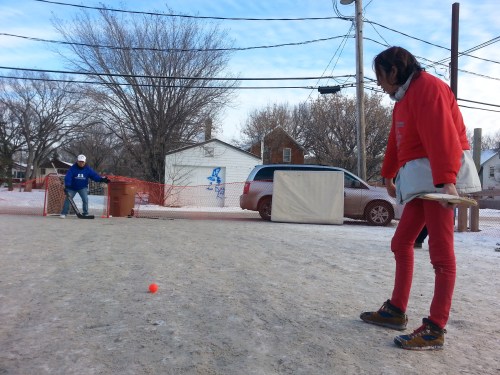
    Sheldon stands at centre ice, eyes closed, visualizing his upcoming slapshot. Noel, the goalie, affectionately known as Ken Dryden, waits with knees bent as much as his battered femur allows. The crowd heckles from the side boards.

    Hockey Day at Carmichael is a pick-up street hockey game played on the uneven, certainly dangerous parking lot of Carmichael Outreach, a crumbling drop-in centre in downtown Regina. On Hockey Day, members of the Carmichael family of hundreds, many of whom happen to be without homes, come to play shinny and eat a hamburger.

    “Hey, Lenny! Keep your stick down, and stop saying ‘fuck.’ There’s kids around!”

    Hockey Day is the only sporting event I’ve heard of where the inebriated and unskilled are encouraged to play. Where new renters can come and settle scores on-ice with their cousins who won’t stop trashing their apartment. Where those still healing from the abuses suffered in the residential school system can come and grind through their aggression. Where people who get ticketed in the mall under the city’s “unwanted guest” initiative come to forget the mall exists. Everyone is welcome to play.

    Deano chases the puck into the corner, hits a patch of ice and lands on his face. He is escorted to the spectators’ bench for having one too many and is given a coffee, a smoke and a cheer from his teammates. Thirty people show up to play, another thirty to watch. The Lemieuxs and Leaches chase the ball with donated jerseys pulled tight over the five layers of jackets that are obligatory when one lives outside and sleeps at Sally Ann or Detox.

    Ivan doesn’t make it as a spectator this time. He just got out of the hospital and being a spectator means sitting outside in the winter on a hard chair for three hours until burgers are ready.

    “I knooow, I know. I still can’t figure out how I got pneumonia.” The week before while Ivan slept, some guests unhooked the smoke detector at his apartment and left the window open all night so they could smoke. “I never even left my bed!” Home care from the health region was supposed to start coming a month before but when he didn’t answer the door once, they permanently discharged him. When so many pieces of the health care, social assistance, and justice systems function in the same defective way, it points to the fact that these are purposeful features, rather than flaws, in the process of colonialism, designed to betray urban Indigenous people.

    “I’m making breakfast. Come over!” Ivan says over the phone on New Year’s morning.

    Ivan wheels himself into the kitchen, fries a pound of bacon, butters two slices of white toast and brings back our feast spread on two decorative plates on the stool of his walker.

    “That’s my team!” Ivan says as the Canadiens walk from the dressing room at the NHL’s outdoor Winter Classic. We’d made a plan to watch the game, this time one that we knew was actually happening.

    Ivan squints hard at the TV, at times mistaking the white and blue vintage sweaters of the Habs for the black and yellow of the Bruins. He needs glasses, he’s asked for them several times himself, but whenever he has an appointment to see any medical professional he refuses to go.

    Montreal dominates Boston in a game of shinny not unlike Hockey Day at Carmichael, except the 80,000 spectators are drunk in some apparently socially acceptable way. He remarks on Carey Price, the world’s greatest goalie, who sits on the bench with a bum knee. Ivan knew the feeling. He recently had a broken upper tibia and a full-leg cast for eleven weeks, half of which he slept at Party Tree, an empty lot furnished with a plank of wood and two broken office chairs.

    “You should see my grandpa’s rink in North Weyburn. Best ice in Saskatchewan,” I tell him. “Sometimes I go there to skate just to get rid of stress.”

    “Oh, for sure. Weyburn, hey? The Red Wings!” he says, referencing the junior hockey club. “They’re a good team. But the Bruins, now that’s my team! Estevan. I lived there eight years. You’re my Estevan Man. I bet I know your family down there.”

    He lists distinctly white surnames. I don’t have any family left in Estevan but since he found out I was born there we never stop talking about the place.

    “I’d walk around with a wagon picking up empties. Ho boy, I’d make a lot, haha. No one down there doing it then. I wasn’t drinking then, could make $60 a day. Could see Boundary Dam from my place.” Ivan sits on his bed, arms crossed, blinking at the TV, wearing an Estevan 1985 Heritage hat I found him for Christmas. The coffee table next to him is littered with insulin pens, empties hiding under his bed. He’s lived in this apartment for three months. Before that he lived nowhere.

    “No guests at all,” Ivan responds in agreement to my suggestion of having no guests after 11 p.m. Too many guests means noise complaints and an empty fridge. He just got out of Medical ICU.

    “Whatever you want,” I say. “And the other part of the agreement is our part. We, as your support workers and friends, agree to respect your privacy, help you get groceries, do laundry, y’know, the stuff we already try to do. And we agree to take you out for coffee once a week. Get you outta your place.”

    “Oh right on. That’s great, man.”

    “I was thinking of getting us tickets to a Pats game. Maybe against Brandon,” I suggest. Ivan spoke of Brandon, Manitoba, another former home, on a daily basis. It was where he and his mind went when he tired of Regina.

    “Ohhh hey, yeah. Alright! Maybe in that agreement put, ‘Take Ivan to a skin show.’ Haha. Jeez, I’m joking!”

    It takes us a week to print the agreement — an attempt to keep his place safe and quiet and keep him housed. It takes another week to laminate it. By then he’d had guests and was in and out of the hospital again. He never did sign it.

    There’s an ambulance outside his apartment as I drive past, so I stop and let myself in with my keys. A paramedic is holding an intravenous bag that runs into Ivan’s arm while Ivan sits eating his first meal in three days, microwaved by the paramedic himself.

    “Heyyyy brother!” Ivan shakes my hand.

    “And who’s this now?” asks the paramedic.

    “That’s my counsellor.”

    “Oh good,” he says to me. “He needs to make sure that he takes his insulin for sure the next day and a half, or he won’t make it. But he can’t take his insulin without eating.”

    He speaks as if Ivan can’t hear. “I’m surprised he’s still kicking. Last time we saw him we were taking bets as to how long he’d last. Glad he’s got some help. If not, these kinds of guys would plug up the system.”

    The health professionals place bets on his existence and call him one of ‘these guys’. Six months later the health region that employs them releases a job posting with blatantly racist language, then rescinds it and claims that racism is not an inherent issue within their institution. I begin to understand why Ivan skips every possible interaction with medical professionals.

    The paramedics get him to sign a release stating that he is not willing to come with them to the hospital to get checked out.

    “Ivan, do you have any other health concerns we should know about?” they ask.

    “Yeah. I’ve got rabies.” Ivan says with a pause, his face earnest. The paramedics look at one another, unsure of what to say. Ivan laughs at them and they leave. Ivan finishes up his microwaved fettuccini alfredo.

    “Hey bro, should we have some tea?” I say yes and go to the kitchen to find the coffeemaker topped up with teabags and the coffeepot already filled with warm tea. I grab the last mandarin orange from the counter, and he and I sit and watch the news and hockey highlights. We drink day-old tea, eat a few orange segments, and as I leave, we exchange our pleasantries one last time.

    “Lock up behind you.”

    I go home and grab my skates and head to the outdoor rink. I skate until my lungs burn, my legs noodle. My head still feels like there’s a bench brawl going on inside, so I skate laps until my head feels nothing. And then I skate more.

  • Advocating for Alcohol Harm Reduction Policy in Regina, Saskatchewan

    Advocating for Alcohol Harm Reduction Policy in Regina Saskatchewan
    Understanding Chronic Addiction and Responsible Public Health Practices
    Nicholas Olson – Housing Support Worker – Carmichael Outreach

    Background

    Severe alcohol dependence is common in individuals experiencing or at risk of homelessness in Regina, Saskatchewan. For individuals who have experienced violent or psychological trauma, alcohol is often used as a way to cope with the mental and physical pain that comes when this trauma is left untreated. Aboriginal populations overrepresent those experiencing homelessness in Saskatchewan and Canada, and many of the traumas they have experienced are directly related to unstable family settings caused by the lasting effects of residential and public schools and other programs created under colonial policy. Homeless populations have a high rate of alcohol dependence and for this reason face significant barriers to stable and safe housing, and are often unable to access shelter systems. In Regina, the few housing support programs that are willing to work with individuals with severe alcohol dependence are finding that the Housing First model is not always enough to keep individuals housed, healthy, and stable. Alcohol harm reduction is the next clear step to support Regina’s most vulnerable.

    What is Alcohol Harm Reduction?

    Alcohol Harm Reduction aims to reduce the harms associated with the use of alcoholic substances in people that are unable or do not desire to stop (International Harm Reduction Association). Harm reduction functions under the idea that all individuals deserve the dignity and respect to be treated in a manner that best supports them as a whole person, not just as an addict, and to be treated medically in a way that is understanding, empowering, and compassionate to their specific needs as a person experiencing an alcohol addiction. For many, the traditional abstinence model is unrealistic and does not take into account the desires of the individual who may not want, or be able, to discontinue use. Alcohol Harm Reduction aims to support the individual to live a healthy life regardless of whether they intend to become abstinent. This may be done by assisting them to consume healthy forms and volumes of alcohol through different programs tailored to the individual, supporting them to be safe during and after consumption, and working with them to maintain good health and, if desired by the individual, to reduce their alcohol consumption overall.

    Alcohol Treatment

    The development of Alcohol Harm Reduction through a Managed Alcohol Program (MAP), Alcohol Swap Program, Beer Co-op, and/or Prescription Alcohol is the best practice in supporting the addictions of a marginalized population in Regina primarily between the ages of 30-55. Since individuals experiencing or at risk of homelessness often have fixed or no incomes, beverage alcohol is unaffordable due to the high cost of controlled substances in Saskatchewan. This, coupled with the marginalization of individuals experiencing poverty, addiction, and mental health, has made beverage alcohol even more inaccessible because these individuals are often not permitted to enter establishments that sell beverage alcohol, and in many cases are unable to even access basic health and emergency services. Non-beverage alcohol (NBA) purchased in grocery stores, convenience stores, and pharmacies including mouthwash, hand sanitizer, hairspray, and rubbing alcohol is being consumed in large quantities because of its potency and availability.

    Non-beverage alcohol can be any form of alcohol that is not fit for human consumption. Ethanol, or ethyl alcohol, is found in beverage alcohol and is safe to consume in moderate amounts. Denatured ethanol, or alcohol denat, found in products such as mouthwash, hairspray, and some hand sanitizers, is ethanol with chemical product added to make the alcohol unfit for human consumption. The chemical additives also allow the producer to avoid the product being designated as a controlled substance. Methanol, or methyl alcohol is toxic and has caused death when consumed through hand sanitizer (CBC). Isopropyl alcohol, found in rubbing alcohol and some hand sanitizers, is toxic if ingested as well. While it is often stated that the extremely high alcohol content in non-beverage alcohol is the most toxic ingredient, with sustained use and high dosage, serious risks are present from the other toxic ingredients in each solution. Hairspray, for example, can have long term effects such as internal bleeding, kidney and liver damage, respiratory problems and death (CBC). Each receptacle of non-beverage alcohol clearly warns of the risks of consumption and strongly advises to contact poison control if consumed in any volume (Pauly 10).

    Alcohol Contents and Types

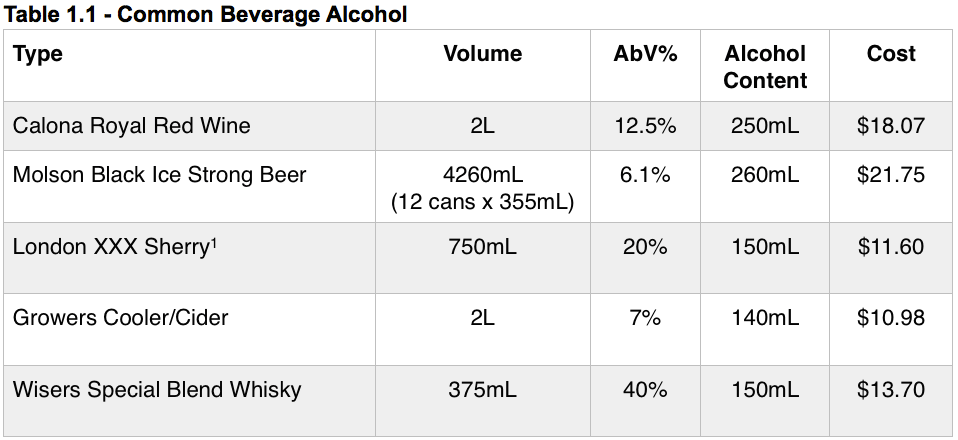
    Table1.1
    (costs listed are based on saskliquor.com)
    (approximate calculations were done at http://www.cleavebooks.co.uk/scol/ccalcoh4.htm and should not be used as a substitute for medical advice)
    1 The LCBO is recalling four brands of sherry (LONDON XXX SHERRY INCLUDED) that tested positive for a potential carcinogen. “This is not like E. coli or botulism where you’re acutely affected. To be affected by something like this, you would have to consume it for a long time for many years, so there is no risk at all,” he said. “It’s very, extremely difficult for anyone to get cancer from this type of chemical, unless you’re consuming it on [a] daily basis and you’re drinking large amounts of it.” (http://www.cbc.ca/news/lcbo-recalls-sherry-for-carcinogen-risk-1.619474)

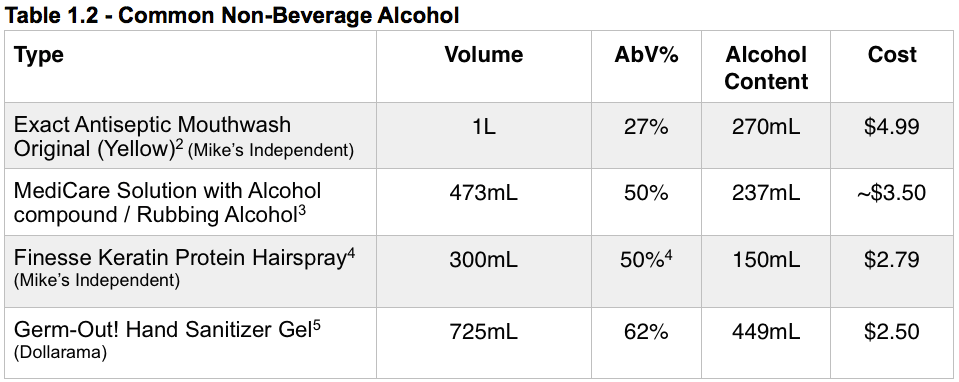
    Table1.2
    (costs listed based on retail prices at given locations)
    (approximate calculations were done at http://www.cleavebooks.co.uk/scol/ccalcoh4.htm and should not be used as a substitute for medical advice)
    2 Medicinal Ingredients: Eucalyptol (Eucalyptus Clobulus-Leaf) 0.092%W/V, Menthol 0.042%W/V, Methyl Calicylate 0.060%W/V, Thymol 0,064%W/V
    Notice: If more than used for rinsing is accidentally swallowed, get medical help or contact a poison control centre right away.
    3 Ingredients: Aqua, Ethyl Alcohol, Denatonium Benzoate, Camphor
    Notice: For External Use Only, Poison, Inflammable. If swallowed, do not induce vomiting. Call a physician immediately. If patient is unconscious, give them air. Danger: Harmful or fatal if swallowed.
    4 Ingredients: Alcohol denat, water (aqua), acrylates copolymer, aminomenthyl propanol, fragrance, octylacrylamide/acrylates/butylaminoethyl methacrylate copolymer, PEG-12 dimethicone, tritely citrate, hydrolyzed silk, hydrolyzed keratin. Alcohol content TBD but could be between 50-70%.
    5 Medicinal Ingredient: 62% Ethyl Alcohol. Non-Medicinal Ingredients: Aqua, polysorbate 20, carbomer, aminomethyl propanol, glycerin, tocopheryl acetate (vitamin E acetate), denatonium benzoate.
    Warnings: For external use only, do not ingest. In case of accidental ingestion contact your physician or a Poison Control Centre.

    Limiting availability of these products has proven to be an ineffective means of managing the consumption of the toxic forms of alcohol, as many or all of those accustomed to drinking non-beverage alcohol regularly travel to the suburban areas of the city to purchase from larger box stores and centres where they haven’t yet been banned. When individuals don’t have to spend their energy finding their next source of alcohol and managing their withdrawal symptoms, it allows them to begin to spend that energy on developing life skills, focusing on housing, setting goals, and working on improving their overall health.

    The only responsible, healthy, and compassionate way to support those who consistently consume non-beverage alcohol is to understand that in these cases abstinence is potentially a dangerous, unhealthy, and unrealistic treatment, and that reducing the harm they are causing to themselves means assisting them with the consumption of safe forms of alcohol. This can be done with Managed Alcohol Programs where individuals are given a regulated amount of alcohol at regular intervals during the day to help them deal with withdrawal symptoms and feel normal and well, Alcohol Swap Programs where individuals not necessarily receiving comprehensive housing supports can swap out certain quantities of non-beverage alcohol for beverage alcohol, a Beer Co-op where individuals are trained in proper and safe ways to brew their own alcohol for safe consumption, and Prescription Alcohol, which like a MAP, would regulate volumes and quantities based on medical assessments and administered in similar harm reduction models such as methadone. These programs, specifically MAPs, have been implemented across Canada and the US to reduce both the harms inflicted upon alcohol-dependent individuals, and the subsequent costs upon the health and justice systems.

    While other potential treatments for alcohol dependence include medications such as benzodiazepines, which include diazepam, or Valium, the lifestyle and the desires of the patient must be taken into account, and for many, discontinuing alcohol use is not desired and is not a possible solution. Using diazepam as a treatment for alcohol withdrawals does not respond to the fact that many individuals would rather not discontinue alcohol use, and even with regulated and prescribed diazepam treatment, many individuals will continue to drink different forms of alcohol when it is presented to them. This would lead to an increased risk of addiction to diazepam, and a “high risk of overdose, loss of consciousness, coma, and death.”(American Addiction Centers) Benzodiazepines are also used as a short term treatment option, with only 1-2 percent of adults continuing treatment for 12 months or longer, and carry substantially higher risks of dependence and misuse in populations with a history of substance abuse (Longo). When supporting an individual living in community, monitoring all the substances that enter the home is impossible, therefore it is best to prescribe that which reduces the most risk and harm to the individual.

    The harm reduction framework aims to support individuals to make healthy choices and this begins with offering assistance in managing quantities of beverage alcohol, and accessing beverage alcohol in a cost-effective manner, while at the same time being careful not to perpetuate the stigma of using non-beverage alcohols that is often present in community supports and medical services. Many populations are stigmatized even within social circles for drinking non-beverage alcohol, and this stigma is magnified in many professional health settings. Following the harm reduction framework means focusing on the needs and desires of the individual, not reducing addictions to a moral or ethical choice, and understanding the barriers that have led to less-safe alcohol consumption. It is important that harm reduction treatments are in place and practiced by health professionals, as professional knowledge is needed to create public health policy that can be safely and confidently administered by community entities.

    Understanding

    Each individual receiving alcohol harm reduction support will consume a different variety, style, and amount of beverage and non-beverage alcohol each day. It is important to understand what the approximate quantities of non-beverage alcohol are to ensure that the proper volume of beverage alcohol is supplied to each individual. Having a set schedule of beverage alcohol consumption would ensure that a moderated amount of alcohol is consumed, which, ideally could be lessened over time based on the desires of the individual. Clinical medical advisement through a MAP or prescription may be required to ensure that the individual is getting a safe dosage, and that an understanding of the individual’s history with addiction and their personal and traumatic history is taken into consideration. In an evaluation of a MAP in Vancouver, BC, alcohol consumption did not necessarily decline in six months for all of the participants, however the consumption of non-beverage alcohol did decline, and most participants reported improvements in mental health, social connectedness, and general well-being, and consumed alcohol in a safer setting with less harms that come from drinking large quantities at one time (Stockwell 6,7).

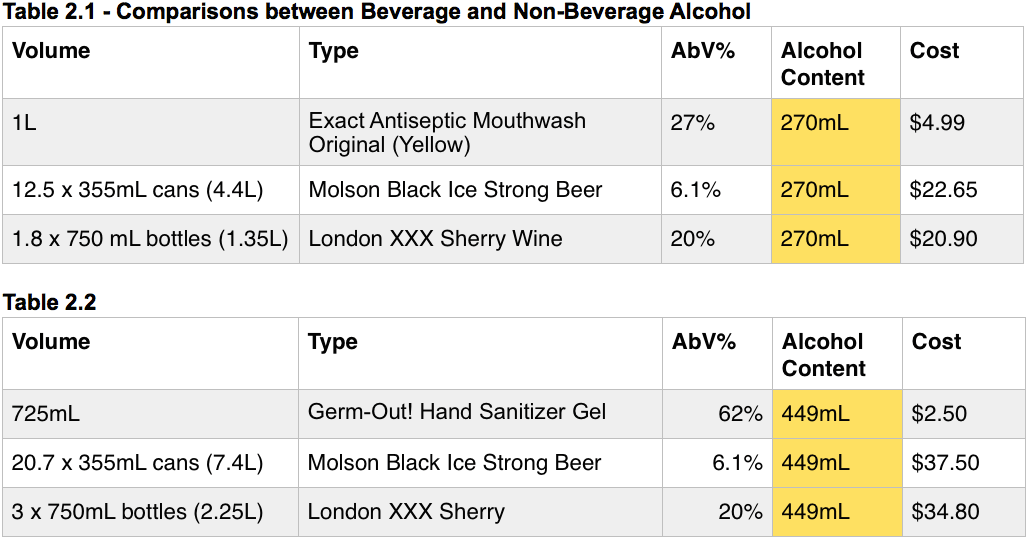
    Below are some comparisons of alcohol contents. Though it is clear that the ethanol present in beverage alcohol is different than the types of alcohol present in non-beverage alcohol (denatured alcohol/ethanol, isopropyl alcohol) and the “high” achieved through using non-beverage alcohol would therefore be different, the comparisons below are a guideline for quantities consumed knowing that the denatured alcohol and isopropyl alcohol have added chemicals that are toxic for human consumption.

    For example, as shown in Table 2.1, one litre (1L) of Antiseptic Mouthwash has an alcohol content of 270mL, which is equivalent to 12.5 cans (4.4L), of strong percentage beer, or nearly two bottles of a strong sherry wine. Similarly, as shown in Table 2.2, it takes nearly 10 times as much strong beer to equal the same alcohol content of 449mL that is obtained through 725mL of Hand Sanitzer Gel. While the point of alcohol harm reduction isn’t necessarily to meet the alcohol content that an individual would consume drinking non-beverage alcohol, it is important for service providers and community supports to understand just how much beverage alcohol it takes to help cope with withdrawal symptoms.


    Table2.1-2.2

    Conclusions

    It is clear both to the uneducated outsider and to the affected individual that the consumption of non-beverage alcohol is extremely damaging to one’s physical and mental health. By offering support to individuals in their addiction through alcohol harm reduction programs, the dignity of these individuals is upheld as they are receiving compassionate medical treatment that views them as a whole person. Through these programs, these individuals would be able to access supports that are often only accessible to less-stigmatized populations, including detoxification programs that in Regina are inaccessible to many with reduced mobility and high physical needs.

    Access to inexpensive, clinically regulated and adequately strong forms of beverage alcohol is key to the physical and mental health and well-being of the individual. Regulated quantities of alcohol must be customized to each individual based on their own personal symptoms and histories. While having professional medical advice involved is clearly the best practice, disallowing access to safe forms of alcohol because of lack of confirmed policy is irresponsible and lacks the compassion necessary in the human services sector and in a responsible community.

    Policy driven by the Regina Qu’Appelle Health Region, monitored and planned by medical professionals, delivered by community organizations, and tailored to the needs of the individual are imperative to the success of an alcohol harm reduction program, and the timely nature of its implementation is extremely important to ensure the safety, health, and survival of a large population of vulnerable people. A responsible community and health region would not allow the continued consumption of controlled poison when clear, simple, and practical alternatives exist.

    Sources
    International Harm Reduction Association, What is harm reduction?, http://www.ihra.net/what-is-harm-reduction
    CBC News, Hand sanitizer ingestion linked to 2 Ontario deaths, Oct 25, 2013, http://www.cbc.ca/news/canada/toronto/hand-sanitizer-ingestion-linked-to-2-ontario-deaths-1.2252046)
    CBC News, Hairspray abuse plagues northern town, Feb 16, 2001, http://www.cbc.ca/news/canada/hairspray-abuse-plagues-northern-town-1.293513
    Pauly, B., Stockwell, T., Chow, C., Gray, E., Krysowaty, B., Vallance, K., Zhao, J. & Perkin, K. (2013) Towards alcohol harm reduction: Preliminary results from an evaluation of a Canadian managed alcohol program. Victoria, BC: Centre for Addictions Research of British Columbia.
    Carnahan RM, Kutscher EC, Obritsch MD, Rasmussen LD. Acute ethanol
    intoxication after consumption of hairspray. Pharmacotherapy. 2005 Nov;25(11):1646-50. PubMed PMID: 16232026.
    http://www.ncbi.nlm.nih.gov/pubmed/16232026?report=docsum
    American Addiction Centers, Dangers in Mixing Valium and Alcohol or Drugs, http://americanaddictioncenters.org/valium-treatment/dangers/
    Longo LP, Johnson B., Addiction: Part I. Benzodiazepines–side effects, abuse risk and alternatives. Am Fam Physician. 2000 Apr 1;61(7):2121-8. Review.,
    http://www.aafp.org/afp/2000/0401/p2121.html
    Stockwell, T., Pauly, B., Chow, C., Vallance, K., Perkin, K. (2013). Evaluation of a managed alcohol program in Vancouver, BC: Early findings and reflections on alcohol harm reduction. CARBC Bulletin #9, Victoria, British Columbia: University of Victoria
    http://www.uvic.ca/research/centres/carbc/assets/docs/bulletin9-evaluation-managed-alcohol-program.pdf