• November 11, 2013

    “This is just a question, but do you consider yourself at fault in the accident?” This was what the apologetic SGI car insurance employee asked me over the phone as I sat in the Frontier Gas Station/Greyhound depot in Revelstoke, BC. I said no, although I should have been driving slower, I should have gotten more sleep the night before, I should have put it in four-wheel drive, I should not have tapped the brakes in panicky instinct. The totalled Nissan Titan, the Rider Pride Truck of 2007, lay on the back of a tow truck in the Classic Towing yard. It is worse crashing a truck when it isn’t yours. When I was certain that the passengers were not affected by the crash, I cleaned pieces of the plastic bumper off the middle of the highway, throwing them into the forest in a stewing rage. After the testosterone-sweating police officer took our information and the tow-truck drove us to town, I left my brother and his girlfriend sitting with a garbage bag of their belongings waiting for the 3pm bus while I stood on the side of the road and stuck my thumb out.

    The words of the pleasant German girl that I sat next to on the eleven-hour gauntlet Greyhound made sense in reflecting on the crash. “You experience more in life when you’re comfortable with being uncomfortable.” Inside of new experience is the place where one is able to improve.

    Near death, if you want to exaggerate the crash to that degree, has been heralded to change peoples’ lives. I’ll always wear a seatbelt from now on, one would potentially resolve. I’ll finally ask out this girl because life is too short, I thought. If life is lived properly, near death should not change anything. It may cause new thought or appreciation. A person should not be scared into living the life they’ve always wanted to.

    Individuals can be personally responsible for their faults. But are they at fault for the patch of ice that brought them spinning off a cliff? Our experiences can cause our faults, but dwelling on our faults, stewing in them, is regression. Once people realize their faults and wish to work on them, there must be proper supports in place; this is a responsible society. From an insurance standpoint, who was at fault is important to establish. But in working on the well-being of a human, who was at fault is unimportant. It is the asking for help that needs to be noticed.

     

  • November 6th, 2013

    In response to November 5th, 2013:

    I am the romanticizer, the unenviable fool. I am a manipulator of words. I turn several years of running away from my problems and write a book about it, glorifying it into an admirable form of ‘roaming’ and ‘wandering.’ I romanticize my gloomy, smug, withdrawn nature as intellectualism and progress. I idealize my lifestyle of work and creation; a prideful and pretentious idolatry. I am likely the only one that strains to see through it all.

    What all who serve an idol fear is death, what Paul calls, “the last enemy.” It is fear of eventual obliteration. It is the fear that death, like life, means nothing. It is a fear we rarely name but which hovers over us. The compulsiveness that drives us to consume too much, drink too much, take drugs or work too hard are bred from this fear of death, the fear that we will no longer exist, the fear that no matter what we do or say or accomplish our life will be meaningless, an insignificant blip on the screen.

    -Hedges, Losing Moses on the Freeway, Chapter 2, p51

  • November 5th, 2013

    There is a crokinole board as a permanent fixture in front of a free hide-a-bed couch. Next to the couch is a stack of books from the library, easily ingested thanks to the lack of distractions of the internet or the television. Next to the stack of books is a bedroll laid on the hardwood with several blankets rumpled up on top. On the windowsill is a bottle of whiskey, two plants, a kerosene lamp, all gifts from friends and family. Next to the windowsill is a rickety card-table/desk with a few more books, a laptop computer. Opposite the desk next to the door is a bicycle which sits upside-down, dripping dirty melting snow and ice onto a tarp below.

    This is my bachelor apartment. I have never been surrounded by such solitude and peace in my life. Nothing I despise exists inside this setting of personality. Only distractions that I wish to have, only smells I create myself, only one light on at a time. No human interference except for when I wish to have human interference. I have abandoned formal education, thus informal, personally motivated knowledge is all I have. If I’m not working, I’m wasting. Accepting the truths of others is irresponsible. Truths must be discovered individually. And truths can’t be discovered when you are living in someone else’s filth. Before this attempt at personal solitude I believed I would miss the unplanned visitors and roommate experiences of living in a home, but now I know that comfort in the presence of people and distraction in happenings kept me unable to progress. Albeit I have only lived here a week, and I will undoubtedly become wretchedly lonely when this couch eventually gives me bed sores.

    Introversion doesn’t necessarily have to mean loneliness, or even solitude. But daily I find myself more inclined to stay home, to be quiet, to read. And while I crave human interaction, I only crave it to the point of surrounding myself with the people I like, and only for short amounts of time. This, also, is largely because the humans I wish to surround myself with have their own adult lives that don’t welcome a third-wheel for extended periods of time. But I do wish I’d have visitors every now and then. I do wish someone would ring my doorbell without telling me via text beforehand that they are going to do so. But my antiquated ways of communication likely won’t be shared anytime soon.

    People often say they hate people, and people usually laugh. But real misanthropy is more than a frustration with the foibles of humankind. Where annoyance becomes misanthropy is the point where one finds himself talking to his plants and never leaving his couch. I can’t imagine a sociable misanthropist, though they may well exist. A person that requires the company of people to relieve their stress, all the while cursing every person for their inanities and selfishness. Either confused, or just diabolical.

    I don’t hate people, but I do talk to my plants. And I do like my own company more than that of most others. The real love of a select few instead of the pretend love of a wide variety is how I survive. When drinking with a group of friends recently, one of the females convinced us to participate in the ‘what we are thankful for’ game while waiting for a cab. And although the cab interrupted my answer, I was thankful for a small group of friends and family that I know would look after me if life ever got too real. I can sit alone for hours comfortably knowing that fact.

  • Coffee is a human right.

    Coffee is a human right, we decided at work today. We have a coffee room so that the ultra-marginalized can have access to that steaming, aromatic, bold flavour to start each morning. As a non-coffee-drinker, coffee is far from something I would ever consider an important provision. Treating people as they ought to be treated, whether or not they can afford to purchase the right to be a customer of a Robin’s Donuts, is an important necessity, however. And if some foreign, non-fair trade caffeinated liquid does that, if coffee does that, then I guess I can support it. Treating people as humans even if they cannot participate in a market economy is a human right, thus, coffee is a human right where I work.

    Water, actually, is a human right. At work, we have cancelled our water service from Nimbus, one of those brilliant companies that sells necessities to spoiled morons who don’t know that it is essentially free in half of the rooms of their home. We cancelled the Nimbus because of cost, but in my mind, because of the classism that comes with letting only staff drink filtered moron water. I drank tap. Water is a human right, but it can be classed.

    Housing is a human right, though most forms of government act as if it weren’t. They watch, coddling the testicles of ‘the market’ in one hand, creating sub-committees out of thin air with the other hand, and let the erect shaft of the market decide. The market, therefore, decides what is a human right. Water and coffee don’t stand a chance.

    The topic of this year’s Blog Action Day is human rights. A few hundred or thousand hack writers delusionally pretend that a cob-webbed corner of the internet constitutes a conversation. The internet is a tool of monitorship and distraction with the veil of community and connectivity. Blogging will not save the world. Forms of virtual kudos and sharing will not save the world. Change.org petitions will not save the world. Blog Action Day will not save the world. You will not save the world.

    Nor will negativity. But nor will the market. And if we continue, as a human species, to live on hope and the poor writing of laypersons on the internet, if we continue to rely on shit media campaigns to start conversations, then sweet fuck, things are going to take a while.

    Blogging for human rights could be equated to smiling to end racism, or clapping to apartheid, or patting yourself on the back to start a revolution.

    Coffee is ready. (This coffee was brewed with good intentions and paid for by the market.)

  • Compliance or Complaints

    The CarpetI used to think selfishness was the basic flaw in most of humankind. That all problems in the world could be cured with a cure for selfishness (see How to Cure a Man, in this award-winning piece of horseshit). This hypothesis is perhaps too flattering to the human species. Selfishness takes the presence of mind to know what a person wants, whether it destroys another human being or not in the process is irrelevant. Selfishness is bold. It is daring enough to step over an injured child on the side of the road to catch a fluttering $5 bill in the tempestuous prairie wind.

    Obedience, a compliance or submission to some form of authority, real or imagined, takes nothing. It takes cowardice and brainlessness. It takes cowering in a corner and an inability to think for one’s self. It takes the physical ability to nod.

    When I consider the ghastly orders obeyed by underlings of Columbus, or of Aztec priests supervising human sacrifices, or of senile Chinese bureaucrats wishing to silence unarmed, peaceful protesters in Tiananmen Square only three years ago as I write, I have to wonder if obedience isn’t the basic flaw in most of humankind.

    -Kurt Vonnegut, Sucker’s Portfolio, Episode Seven – The Last Tasmanian, p132

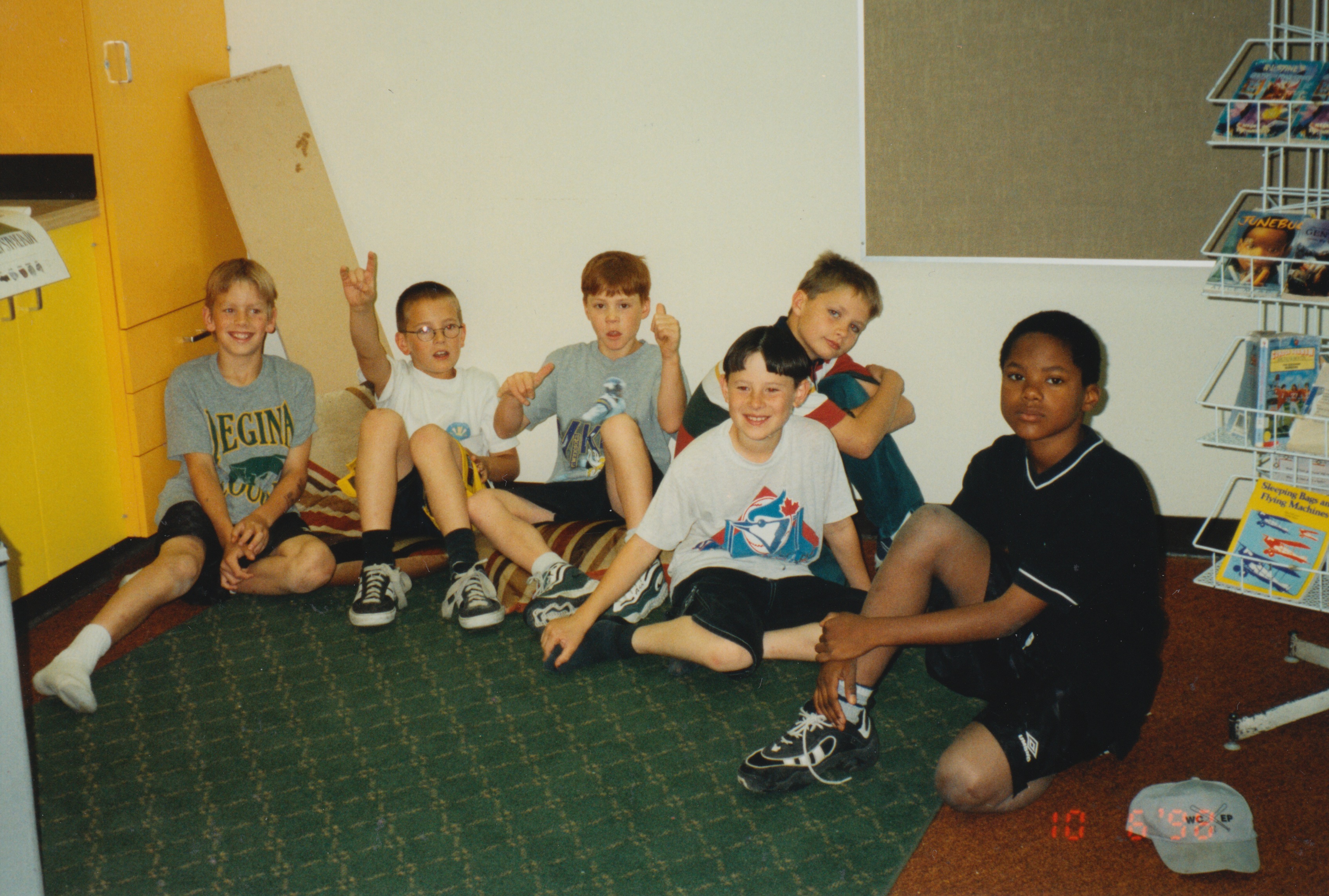
    As young mushroom-hair-cutted brats of 1998 (photographed above) we were taught to be compliant. Schools are dens of obedience. Being conditioned to work well with others, to finish projects without accessing the portion of your brain that requires questions that make the teacher do more work. Being conditioned to keep quiet and not to ask stupid questions. Conditioned to see the virtues of obedience as opposed to those of knowledge. To avoid sounding too conspiratorial, I will avoid using the term ‘the system’, but the molding of impressionable sock-footed suburban kids is done intentionally to make a smoother transition into the system of obedience. (Dammit, I said ‘system’.) When we come out as full-fledged adults, procreating in healthy uteri or test-tubes, spending money and buying dinnerware, we are well-prepared to nod our heads when told what to do by the prevailing order.

    We are taught to obey politicians, those brave and intellectual souls who do what is best for their country without even a thought about themselves or their friends’ corporate interests. We are taught to obey societal and relational norms and end up reclusive, in debt, and lonely. We are taught to obey the market, the ultimate form of democracy, the system that leaves no one behind. We are taught to obey the status quo.

    Without rebellion from the opinion of corporate powers (even as minor as voting yes), souls will continue to be crushed by the forces that originally indoctrinate children with obedience. Without disobedience, creative thought would cease to exist. Without disobedience, those in power will continue to rape the land without end. Without disobedience, the population, you, will be complicit in everything you hate.

    In works such as On Power and Ideology and Manufacturing Consent, Chomsky has, more than any other American intellectual, charted the downward spiral of the American political and economic system. He reminds us that genuine intellectual inquiry is always subversive. It challenges cultural and political assumptions. It critiques structures. It is relentlessly self-critical. It implodes the self-indulgent myths and stereotypes we use to aggrandize ourselves and ignore our complicity in acts of violence and oppression.

    -Chris Hedges, Death of the Liberal Class, Chapter 2, p35

    Obedience is death.

    Deciding which is a worse human abomination, selfishness or obedience, is maybe an impossible task (like Oprah vs Dr. Phil, or politicians vs lawyers) and wouldn’t accomplish much. We are naturally selfish, and this is something that we will never grow out of. We are taught to be obedient, however. It is easier to unlearn something learned than to override a natural instinct.

    Blind obedience is foolish. Selfishness is barbaric.
    The fool is cowardly, while the barbarian doesn’t know better.

    It doesn’t really matter which is worse, it matters that we can acknowledge both in our own person. Let us unlearn, then let us defy natural instinct. Our children’s haircuts will be all the better for it.

  • Lyrics of the Month: September 2013 – Wild Card

    Here’s to the wild cards, the compassionate few. Whose faith is not contrived, sold, or rigged up to the sky. For those who are sailing a little far form the shore, who don’t know for certain what they’re sailing for. They say that everlasting life is away from these shadows. I wanna be where the angels turn away, I wanna hide where the devils find a little bit of light. I wanna know is a wild card still worth something? Every injustice has a system, every city has its walls, every righteous claim has its burden, every luxury has its cost. So here’s to the overlooked, those who might never fit in. The castaways and junkies, young queers and Indians. They say that everlasting life is away from these shadows. I wanna be where the angels turn away, I wanna hide where the devils find a little bit of light. I wanna know is a wild card still worth something?

    Northcote, S/T, Wild Card

  • Children and Why I Hate Them

    Carmichael Kids' Camp

    I recently had a long, meaningful conversation with a former girlfriend when she said she had learned a lot about herself in the past several weeks. I asked her specifically what these were. Among more profound familial lessons was her new life decision that she was never going to have kids. She had expressed similar sentiments in the past, but it had since become definitive, and unless something changes significantly in her life in the next ten years, she said, that is how it is going to stay. As her former partner, when she would bring forth such ideas in the past, I would be selfishly disappointed of such a bold statement as if it were an avoidance of commitment (like this is something I should ever be sour about), but now, after a week of heading up a Kids’ Camp, I can understand her new realization. And though I would never plainly state what she has, I am currently examining the possibility that I hate kids.

    Thirty-six community children ran my ass ragged through their extreme energy and stubborn defiance to simple participation. Their guiltless tears and their visible joy of catching frogs disgusted me. I shouted more than I spoke. I swore at children in utter resignation. I wished for their demise under my breath, and sometimes over my breath. I could tell which children had structure and discipline in their lives, and tried to rationalize the multitude of the children’s flaws with the difficult lives of their parents. But mostly I blamed the children themselves.

    Nearing a quarter-decade of life, my peers are deciding that their libidos and personal energy can be well-spent on the magic of progeny. This is admirable. What has been called ‘our greatest resource’ is comprised sadly of miniature caracatures of the absolute worst of ourselves. The disorder-diagnosed, bed-wetting, pill-prescribed, blatantly selfish human beings that will one day be the drivers of our communities and councils of our cities. Tar sands seem almost preferable.

    People always say that it is different when it is your own kid, a truism that I cannot speak to. And I guess that is something I could look forward to; the chance to unimpededly warp the mind of a human unlike I have ever been able to do before because of previous parenting/brainwashing. My closest comparison is eating a rotten vegetable from my own garden; it somehow still tastes better than the neighbours’.

    The one kid at camp that wasn’t addicted to meat, sugar, video games, or attention, still managed to annoy me. He ate what I ate, he enjoyed reading rather than pestering other children, he was interested in science. But because his parents (with whom I likely have much in common, who likely eat the way they eat for presumably the same reasons as I) brainwashed him to a painful degree, it bothered me. If my child grew up with my exact ideals, I’d be disappointed; zero surprise, zero independent thought, zero digression. Zero evolution.

    But children, you may say, are impossible to hate. Their crooked teeth, their high pitched voices, their clear vulnerabilities. Their innocence and foibles and miniature features that formulate the broad term of ‘cute’.

    When I drove back into town, minivan exploding with bottles of old condiments and lost-and-found underpants, I waited at a red light next to the gaudy yellow lettering on forrest green back drop of the lamest chain store in the world, DOLLARAMA. I waited at the red light behind a massive SUV with stickers on the back window—stick-figures representing each member of the family including dogs and cats, but with the former father-figure sticker visibly scratched off. The truck next to me, the ultimate fan, had an upside-down novelty Roughrider license plate, showing off his true partisanship and devotion to ignorance. The light turned green and I grinded my teeth.

    Parallel to my former partner’s realization, I could say I have come to my own. I do not hate children. I hate who the children will inevitably end up being. That is, their parents. I hate their future selves and their parents for reasons that I just now understand. Because they are both selfish, ignorant morons. But this examination also reveals that I hate children because they make painfully evident the things that I loathe in myself. Over-controlling, short-tempered flakiness that I despise in others, and only see in myself when I am telling a child named Denzel that he is an idiot. Though I have been well aware of the fact for sometime, it was humbling to see how unprepared I am to be the guardian of offspring.

    I hate the children because the children are me.

  • I’m a burner

    Burnout rate is high, they said during my first week of work. And I laughed. The new director and new boss started the staff meeting with handouts. Staff meetings were still a novelty. They handed out a booklet about boundaries and ‘compassion fatigue’. Internally I called bullshit, and I mostly still do. Boundaries are a way for people to back out of doing their job properly because of personal discomfort, I figured. And I mostly still do. ‘Compassion fatigue’ is a nice way to say burnout. But I mean, there are websites about it. Legitimacy reigns via the internet.

    Choose your adventure Route #2 – The Less Depressing Route: If my continual burnout, like blisters upon blisters or scabs upon scabs, doesn’t impress you, or is something you’d rather avoid reading because it may cause second-hand depression, then refer to this site which takes what I so eloquently complain about and turn it into relatively humourous internet one-liners. If you’d prefer to delve deeper into the cave, read on.

    A year later there is a complete staff overhaul due to pregnancy (also known as future-mom-burnout) and likely self-diagnosed ‘compassion fatigue’, and I am desperately searching my file-folder shoeboxes for that handout about boundaries. I am a goddamn burnout and it wasn’t mood-altering substances that caused it. My moment of realization was when I was in my beneath-the-stairs office and some oppressively bad country music came charging into my ears. I almost cried real tears in total resignation. I held back and ate a box of Oreos instead.

    Once, in a similar mental state of exhaustion as I am in now, I joined friends to partake in the initial social act of becoming a true burnout; the joint-smoking part. It was great until I realized that I forgot the work van at work and almost got hit by a truck while bicycling back to get it pretending I was flying in a hangglider. Solving burnout with burnout doesn’t work.

    And thusly I slip into habits that oppose my values. Laziness in diet. Reliance on the relaxation of beer. Mindless screen time. The norm does not seem normal. Mine is far away and theirs is just not right.

    Then today, at a staff meeting in a coffee room that has shifted ten feet east, with faces that shifted once clockwise, while I sat off of the round table, shucking peas from their pods, I raised concerns (complained) about the job I love so much. Trying to find ways to make sure the job I love doesn’t become any more unlikeable, because then these blisters upon blisters might just pop. We didn’t come up with a blister solution and I didn’t find that sheet about boundaries. I guess I will continue to have none.

  • Indians and Indians

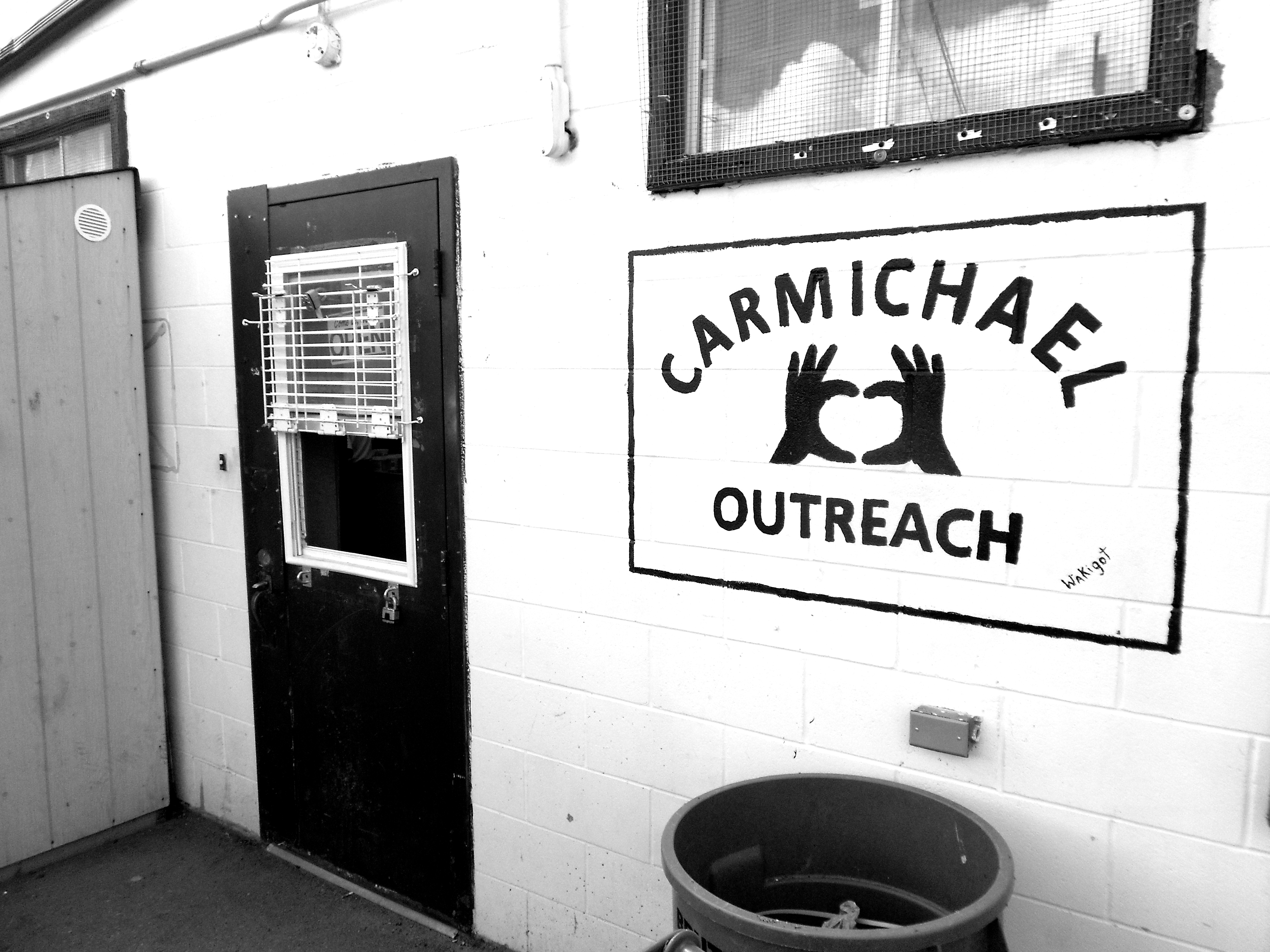
    Carmichael WindowThe Red Indians. That is how I remember friends from India refer to Aboriginal peoples in North America. Please excuse the politically incorrect nature of the title of this essay.

    As Cook and Food Recovery Program Coordinator (the more words you have in the title, the more important you are on a global scale) one of the duties is to run a nutrition program. If my roommates are a typical sample selection, I can guarantee that I eat healthier than most single men my age, but in no way does this qualify me to pretend I know more than mothers-of-five or middle-aged men. I stumble through repetitive weekly sessions about budgeting and Canada’s Food Guide for First Nations, Inuit and Metis populations trying not to brainwash them into vegetarianism that could realistically jeopardize their culture. Currently, the program consists of several Aboriginal mothers and fathers and one Punjabi woman with no children.

    Daily I feed hundreds of people who lack a regular source of healthy food. I attempt to do this with absolutely no ability or knowledge in serving them food that respects their culture, let alone their dietary preference. I serve westernized semi-processed foods out a back window to people verging on physical malnutrition and cultural assimilation. Carmichael Casserole or Spaghetto and Meatsauce sustains their bodies for a while longer and at times it doesn’t even achieve that. I am overwhelmed with how little I know.

    Then I read such articles. Things which are 100% relevant to my current position and I begin to reel. If the government or people are not willing to properly reconcile, then I become immaturely overwhelmed as to how to do so out of a 6′ x 6′ kitchen. Leanne Simpson, Indigenous author, writes:

    “I wonder how we can reconcile when the majority of Canadians do not understand the historic or contemporary injustice of dispossession and occupation, particularly when the state has expressed its unwillingness to make any adjustments to the unjust relationship….

    It reminds me of an abusive relationship where one person is being abused physically, emotionally, spiritually and mentally. She wants out of the relationship, but instead of supporting her, we are all gathered around the abuser, because he wants to ‘reconcile.’ But he doesn’t want to take responsibility. He doesn’t want to change. In fact, all through the process he continues to physically, emotionally, spiritually and mentally abuse his partner. He just wants to say sorry so he can feel less guilty about his behaviour. He just wants to adjust the ways he is abusing; he doesn’t want to stop the abuse.”

    -Leanne Simpson, Dancing On Our Turtle’s Back

    I cannot host reconciliation out of a kitchen. And this is because, according to the synopsis of Simpson’s book (see the above link), “reconciliation must be grounded in political resurgence and must support the regeneration of Indigenous languages, oral cultures, and traditions of governance.” I cannot catalyze reconciliation because I do not really understand the historic or contemporary injustice of occupation. And that is what gets me. Reconciliation is not done solo out of a grimy kitchen. It is done through processes which may have nothing to do with me and steps which I cannot control, but processes and steps in which I can participate in some way. Processes which I can learn about to potentially approach a climate that is fair for future reconciliation.

    The fact that I cannot adequately express my intentions with the word Indian demonstrates my obvious inability to help promote and preserve a culture that is not mine through an ill-prepared nutrition program and sloppy meals. The infinite nature of my naiveté and glaring inability is burning me out. They make me want to run away to the land of the Not-Red Indian in a fit of hedonistic, selfish admission of my lack of knowledge. My lack of commitment. My lack of connection to the issue, which is maybe the worst part—that I could get on a plane and forget about hundreds of years of colonialism and assimilation, because I can.

    I am here to stick around for as long as I can before my brain explodes and I find myself crying in some colonially-cultivated blossoming organic flax field, because I do not want to “adjust the ways” we have been abusing, rather I want to stop the abuse. One of the only ways to do this is participation, knowledge, and handing out egg salad sandwiches to two-hundred people a day.

    Or at least that’s what I’m going to tell myself so I don’t drown in egg salad.

Is this your new site? Log in to activate admin features and dismiss this message
Log In