
Category: Travel
-
Parasitism
As a renewed cellphone-free man I drink the heavy nectar of wi-fi. I sense when it exists and where it exists and how to position my body and tilt my neck to best receive the finely-tuned wavelengths into my lungs and my soul and my device. I have given up on pride and ask even the least appropriate places for their security codes, their passwords to open the sesame of my personal communication. Restaurants, bars, party/costume shops, hotels, homes, parks, community centres, libraries.
“Excuse me, what is your wi-fi password?” is like admitting your poverty and asking for change. People look at you, notice that your device is seven generations old and scoff. I sit in the corner and send messages to mom in India. Last night at midnight I stood in the cold outside of the local cafe and sent messages to travelling friends. The addiction is real. But I distance myself as best as possible which is why I am now a parasite.On my previous bout of unemployment I tagged it as the Freeloader trip, but I understood that this was an slightly more endearing term of what it really was: parasitism. Attaching to and sucking dry those connected to me that have vision and ambitions and talent and patience to see their goals through and somehow have room for a tapeworm in their process of progress. I “sold t-shirts” for Close Talker, coming up with a completely unnecessary job so that I could watch free music, travel, see friends, and drink too much. I will move to the farm to help a friend herd cattle and build a home on his century-old homestead, neither of which I know anything about. I will go to a new city to potentially participate in a friend’s grand project of opening a particular kind of pizza joint. I will latch on to progressive people of diligence and industriousness and hope that in my blood-sucking, what I admire in them will be transmitted to me.
Then, when these months are said and done I will travel to countries that want nothing to do with another white man but will put up with it for the sake of an economy that is the tourism industry. And I will feed off of their land and their labour and their inexpensive living for my own personal benefit. I will inevitably further damage relationships because even responsible tourism is harmful. And with any luck I will come home six months later with a gnarly stomach worm, a parasite of deadly origins, and I will learn what it is like to be the host of someone who isn’t capable of envisioning their own future.
-
Letter to the Board
Letter to the Board,
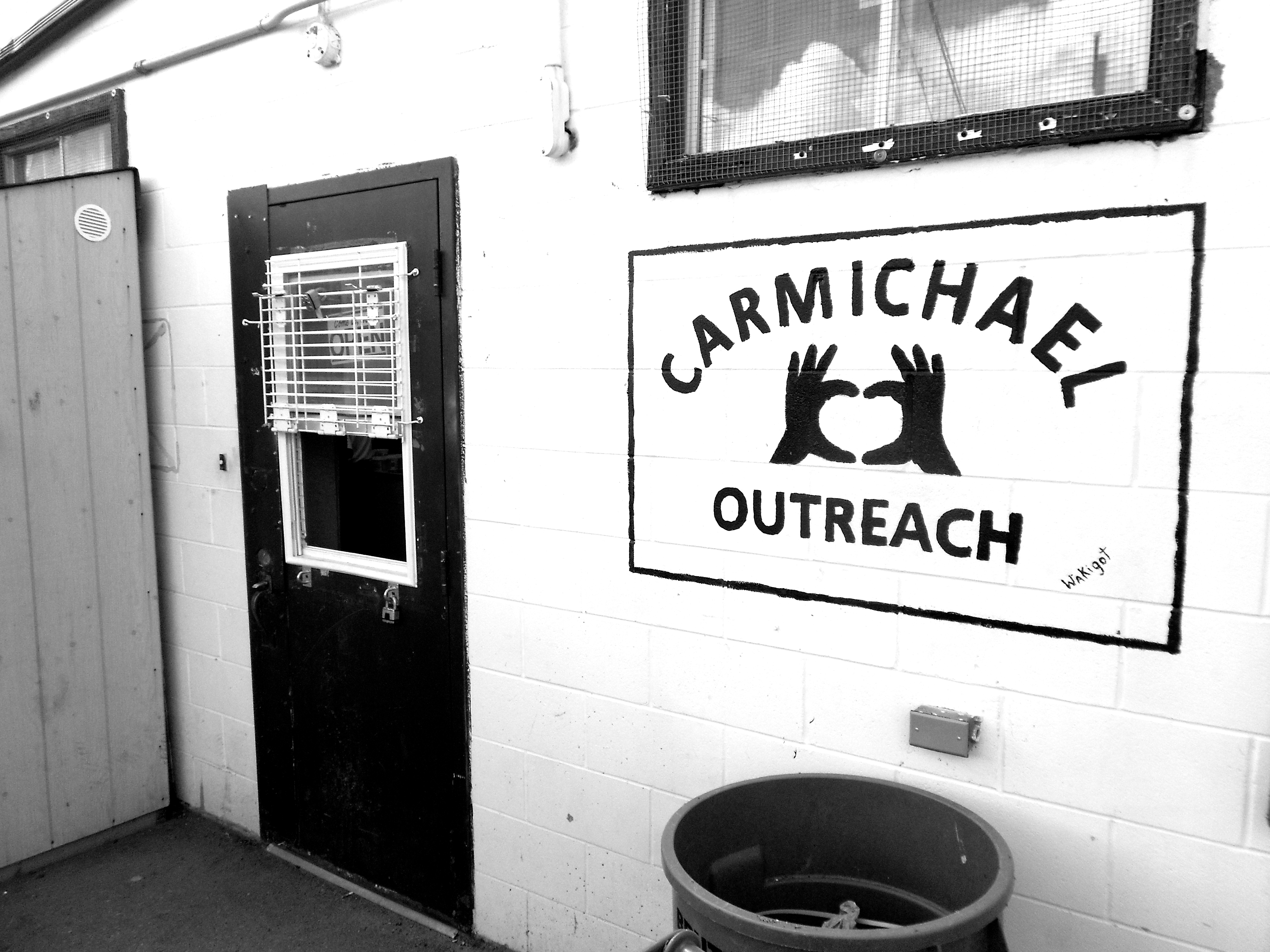
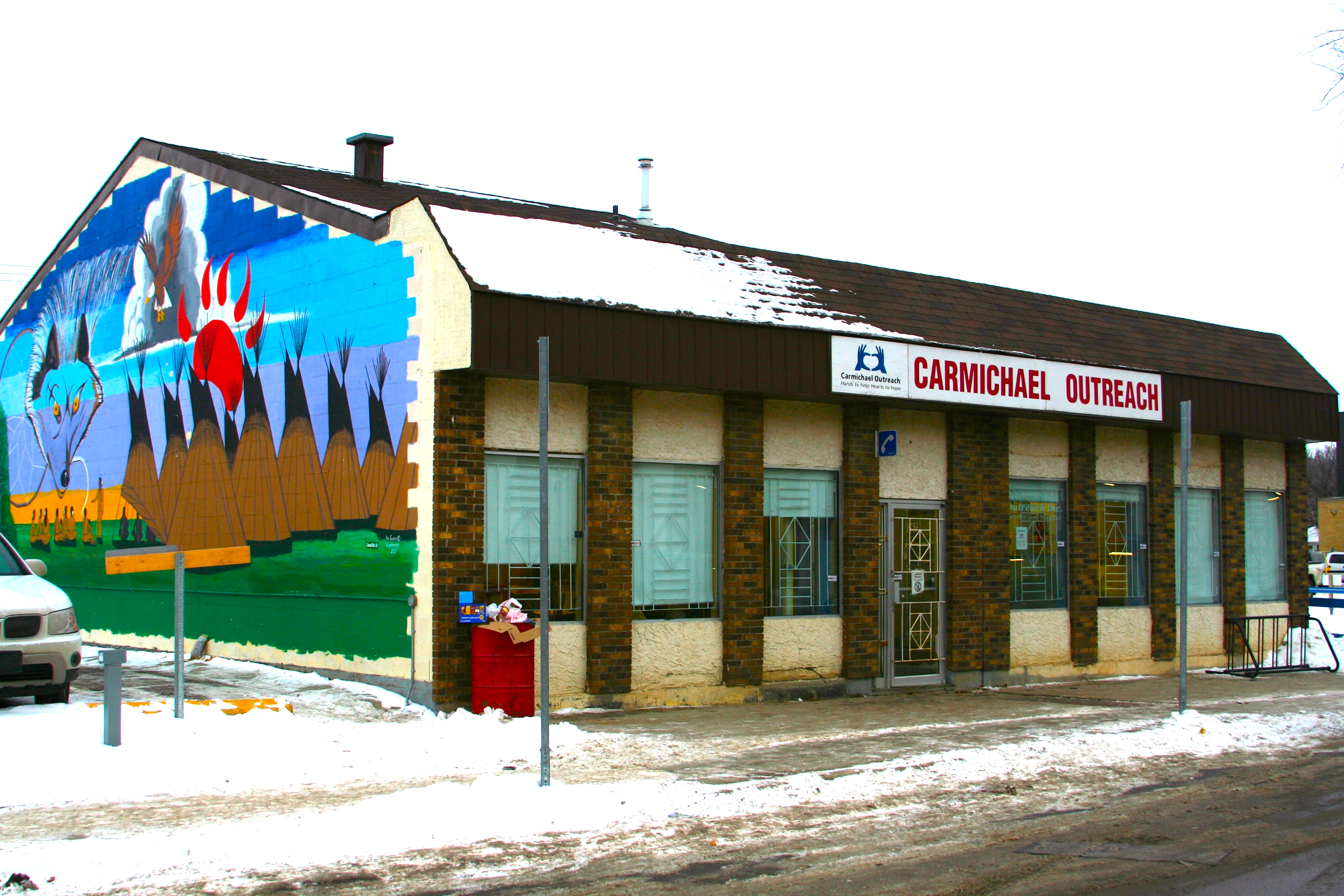
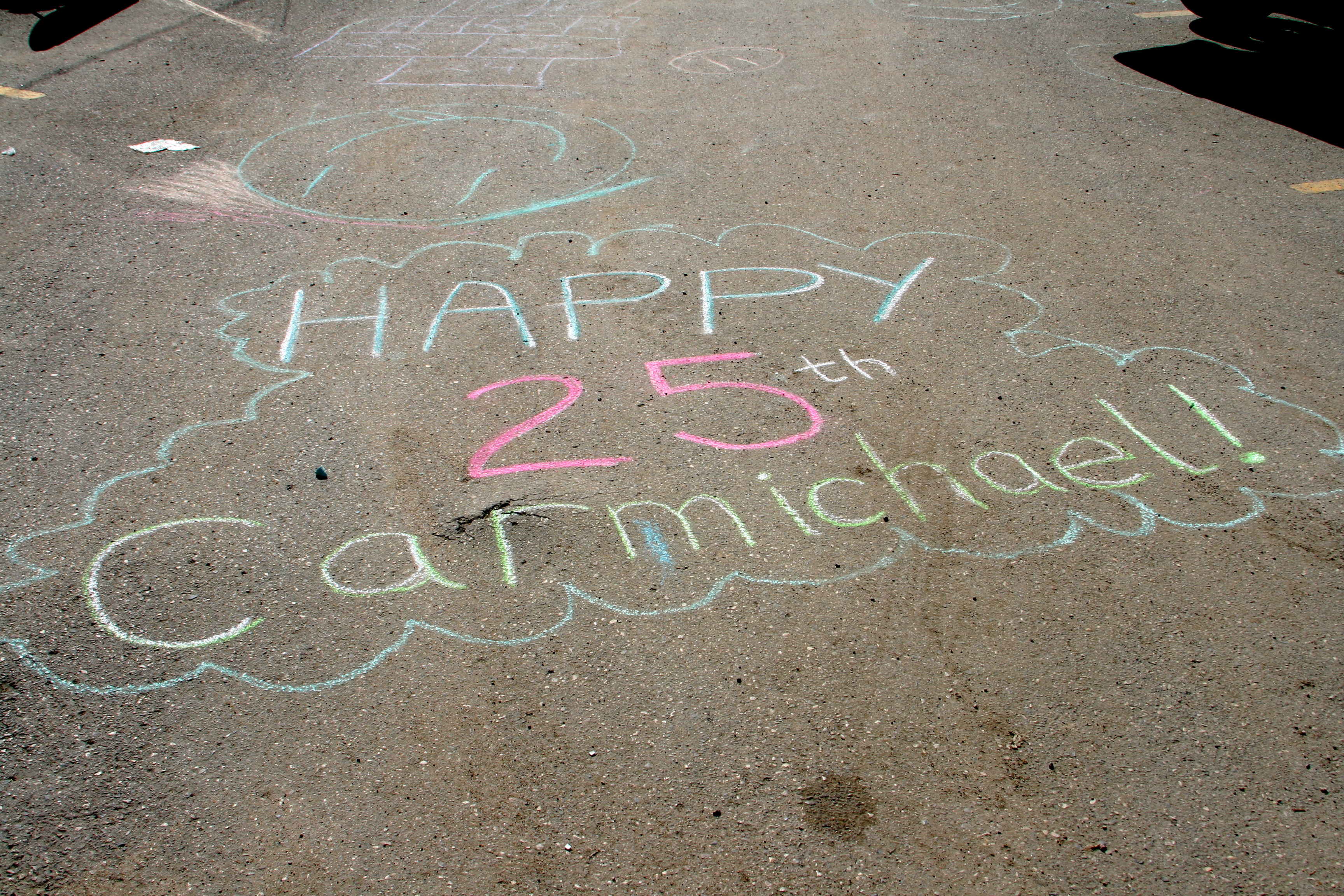
Carmichael Outreach is a unique community unlike any other within the city of Regina. Community members, occasionally referred to in the pejorative as ‘clients’, use Carmichael for its services and programs, which are often as unique as the community itself. Community members also come to Carmichael for a sense of dignity, belonging, friendship, and community. Where most people find this in their own homes, Carmichael community members make their own family, and use the coffee room as their living room. I have experienced no greater example of belonging, dignity and respect.
The reasons a place like Carmichael has to exist is complex and longterm. Poverty, addiction, mental illness, abuse are complicated human issues that will never be solved by the harm reduction programs run out of a small, dilapidated building with an overrun staff. But the decisions that that individuals and organizations make that cause these issues are clear, and as a non-profit, very avoidable. The systems of capitalism and colonialism are the root cause of the issues that tax the lives of the Carmichael community members. Capitalism is the economic model used by Canada’s colonial past and present. This economic system not only took over Indigenous land for the sake of giving land for new homesteads, but has played the largest role in the destruction of the traditions and governing systems for the fact that capitalism cannot exist in the presence of other traditions. The traditions and governance of Indigenous peoples are the polar opposite of capitalism, which is why colonialism had no choice but to assimilate and exterminate.
As a community-based organization, Carmichael has the distinct opportunity to stray from its current model of governance, that is, treating the non-profit as it were a multimillion dollar company, and to treat it like the living, breathing community that it is. Top-down, hierarchal decision making has worked superficially in the past and works in other contexts, but running Carmichael in such a manner only perpetuates the reasons Carmichael has to exist in the first place. Decisions, economic and otherwise, made for a community’s well-being without direct involvement or even simple consultation of that community, will be uninformed and detrimental to healthy functioning.
A shift to a more communicative, cooperative model of governance, still based in the Canadian laws for charitable organizations, would greatly benefit an agency like Carmichael Outreach. Board members offer a unique outside community perspective with business and executive expertise, while staff bring a frontline, community-member voice imperative to the balanced and equal decision-making to ensure that the customary neocolonial top-down approach of running an organization doesn’t take hold. Carmichael community-member input, more than once a year in patronizing AGM meetings, is imperative to the inclusion of the most important demographic; the service-user. To expect the opinions, ideas, plans, and dreams of hundreds of community-members and dozens of staff members to be filtered through a single Executive Director position is not only ineffective and impossible, it is unfair to charge the Executive Director with such an overwhelming task. Communal decision-making ensures a transparent, efficient, and effective process, and one that could slowly be transitioned into simply by allowing a Carmichael staff member to participate in the board meetings each month. Such a change would bring board members into a far greater understanding of daily operations at Carmichael, and would give staff members a clearer understanding of the necessity of process in an organization of this size. This transition could be complete with running Carmichael as a cooperative community movement that includes people of all backgrounds, incomes, and visions together in one common goal of continuing the important community work at which Carmichael already succeeds. Community requires such social mix, and a community organization’s healthy functioning is no different. Greater communication between stakeholders of Carmichael Outreach can only improve the future strength and effectiveness of such a community. I ask that you please consider a more cooperative and communicative approach to the operations of such a strong and critical community in Regina as it would be a disservice to the service-users to run it in any other way.
I have not, and likely will never again, work in a place such as Carmichael, and I know its potential far outweighs its current impact, which is a significant statement considering Carmichael’s influential past and present. Please consider decolonizing Carmichael’s governance and shift to inclusive and cooperative styles of governanace that truly can benefit such a distinct community.
Thank you for allowing me to be a part of this organization.
Nicholas Olson
-
World Crokinole Championships – The Great Paternal Experiment
The following piece was featured on Ominocity.com out of Saskatoon, Saskatchewan.
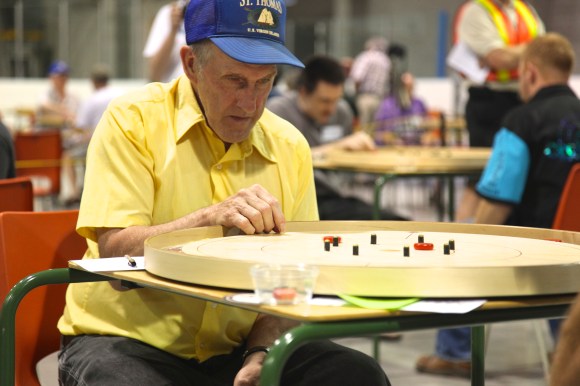
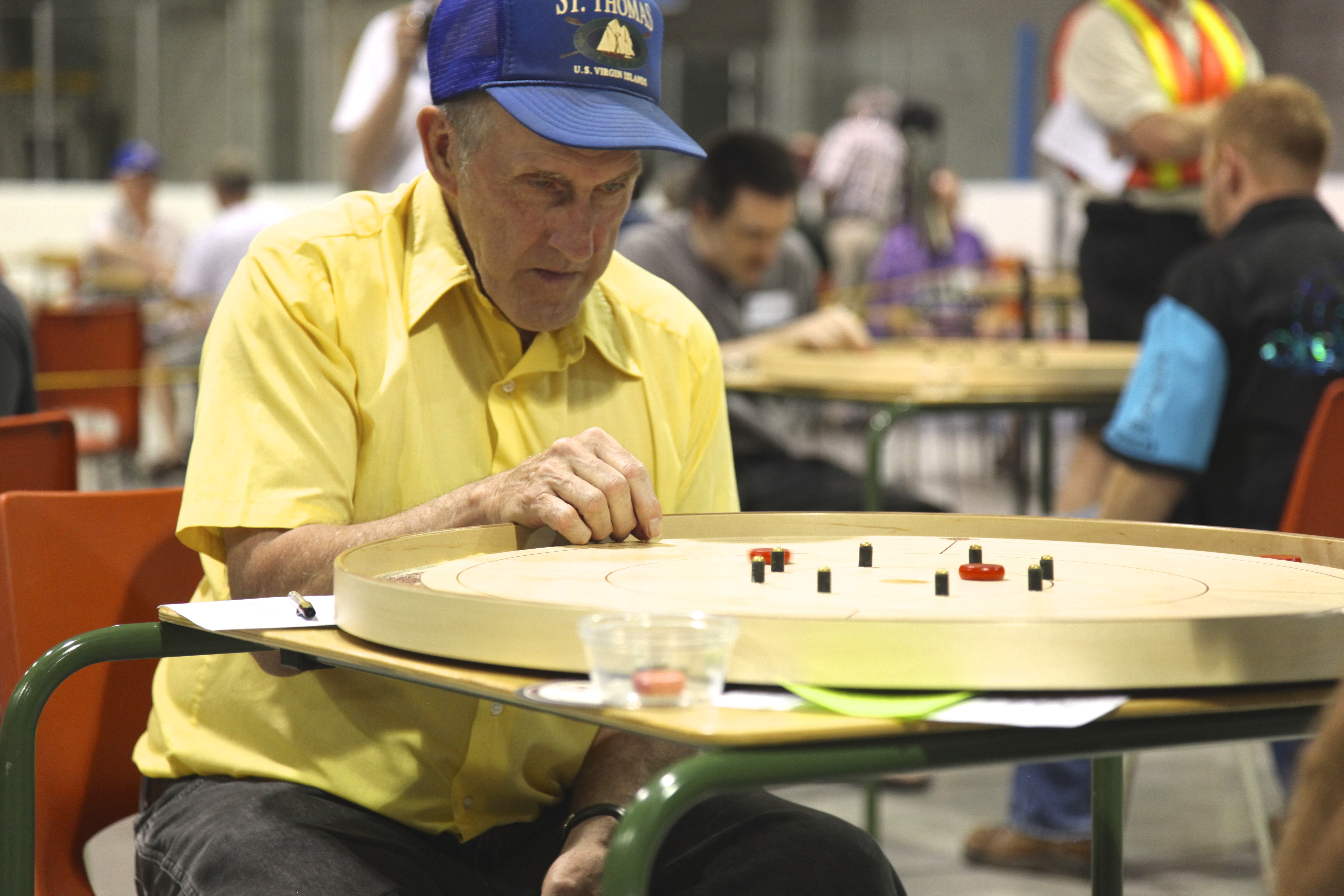
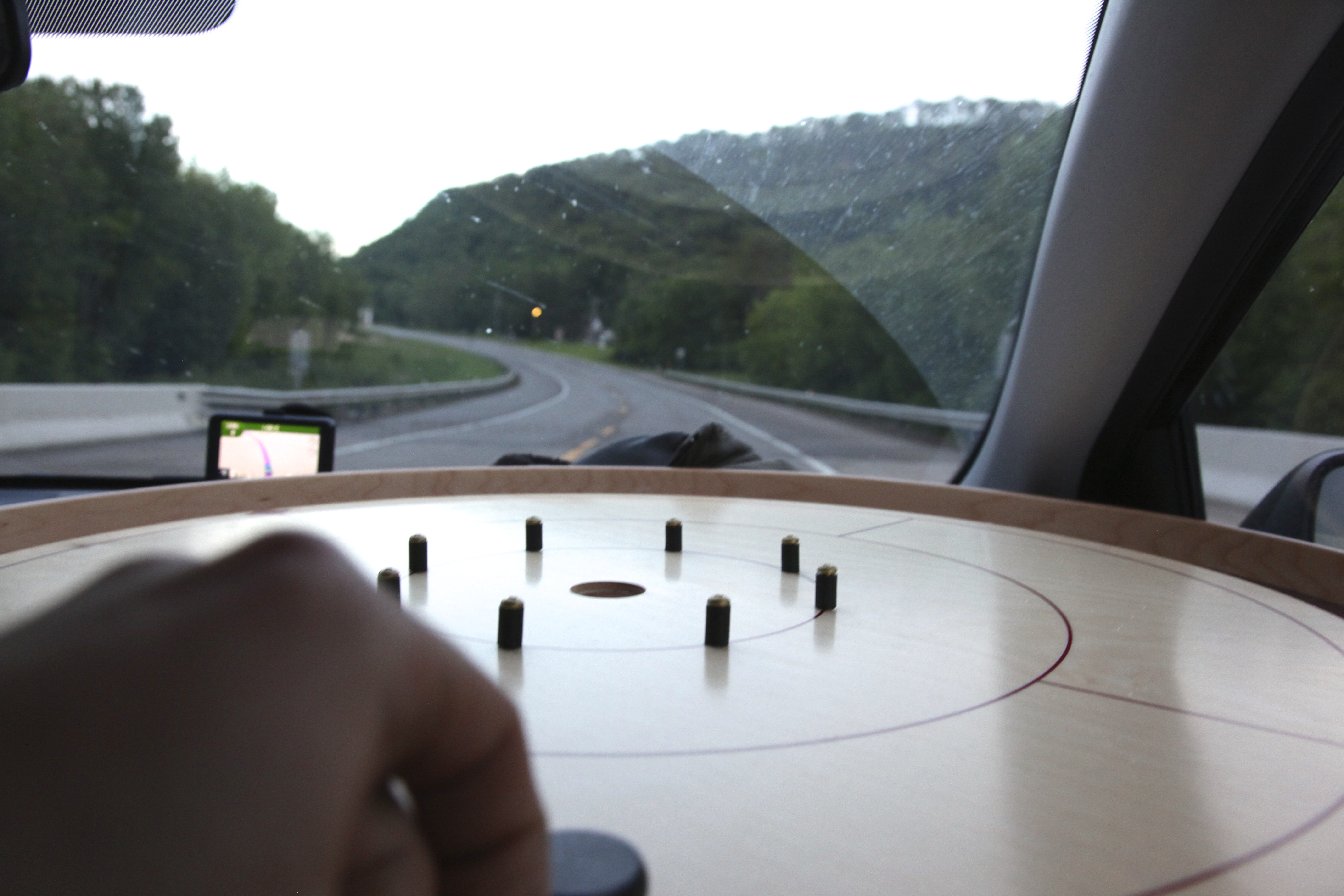
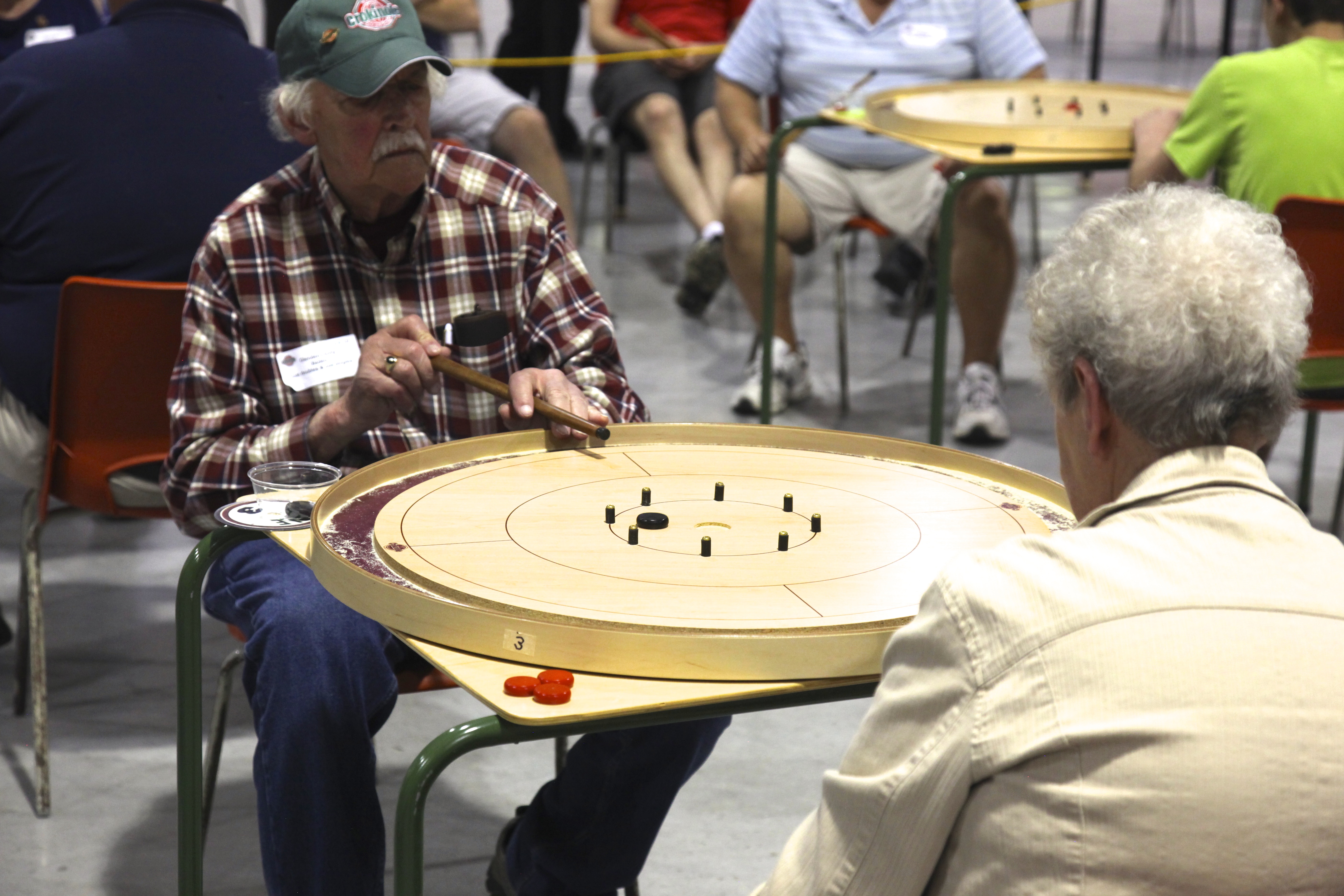
If you’ve never heard of crokinole, you’re likely not a citizen of the disintegrating Canadian countryside. If you are from the North of 49 and you still haven’t heard of crokinole, you either a) are from a city, b) didn’t grow up in a church, c) grew up with a Nintendo, or d) had unloving parents. Crokinole is a two or four person game played on a 66cm-diameter circular board, in which each player has a determined number of discs made of lathed wood. Each player purposefully flicks these buttons with a finger or wooden cue towards a hole in the centre of the board a quarter-of-an-inch deep and only slightly larger than the button itself, attempting to avoid the eight stationary pegs that guard it like pawns on a chess board.
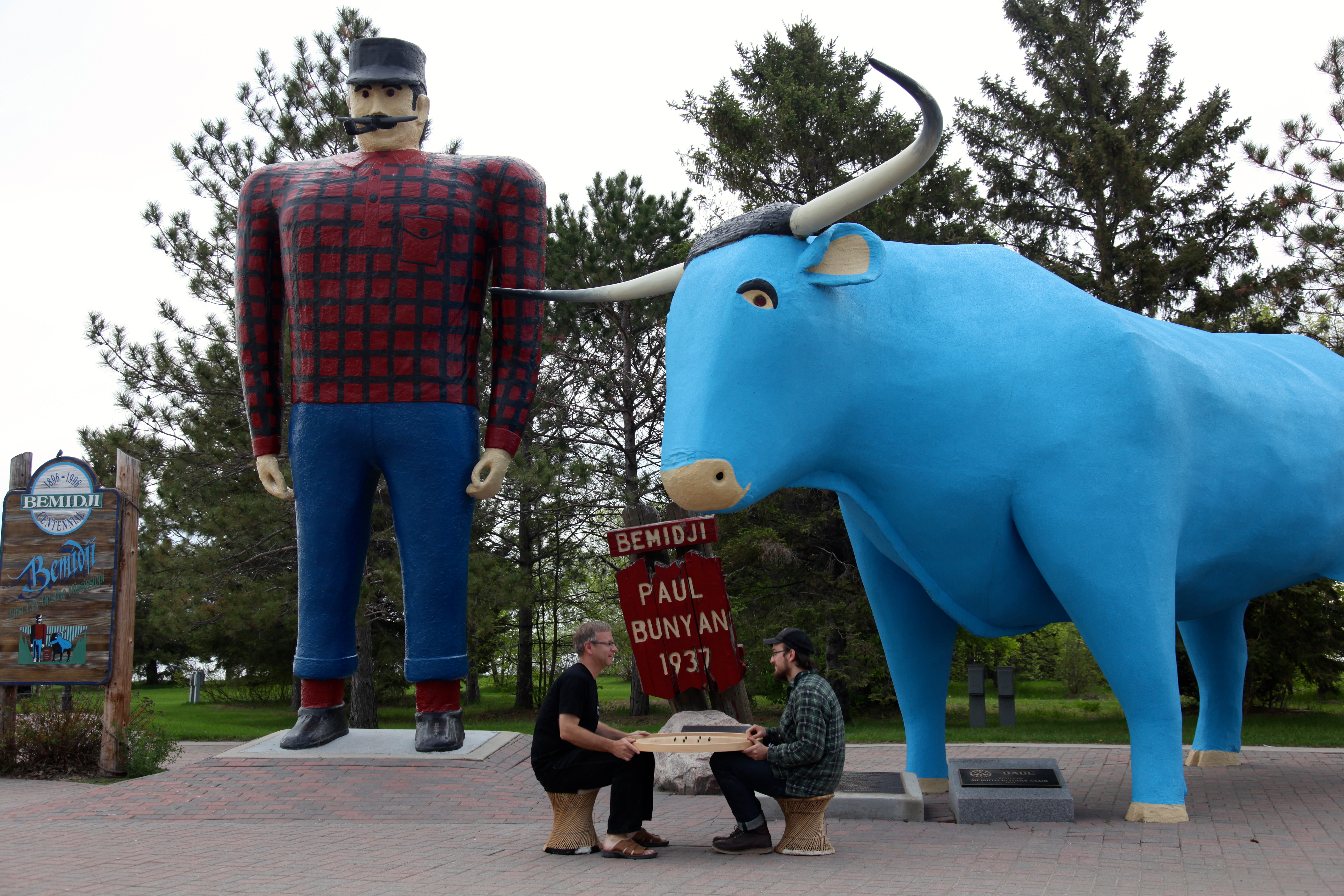
It is a game you may have played with your loud uncle and your wrinkly aunt before Christmas dinner. A game in which your grandpa is likely indomitable in between heavy naps in a dusty cardigan on an itchy couch. It is a game you may have tinkered with not knowing the rules (of which there are perhaps three), or, as previously determined, a game you may not have ever even heard of. For myself and my father, it is the game in which we competed at the World Championship in Tavistock, Ontario on June 1, 2013. The World Crokinole Championship, widely revered as the Stanley Cup of crokinole tournaments, the Kentucky Derby of the forefinger stallions, centre stage of peculiar rural males aged 39-88, was obscurity and sportsmanship perfectly defined.
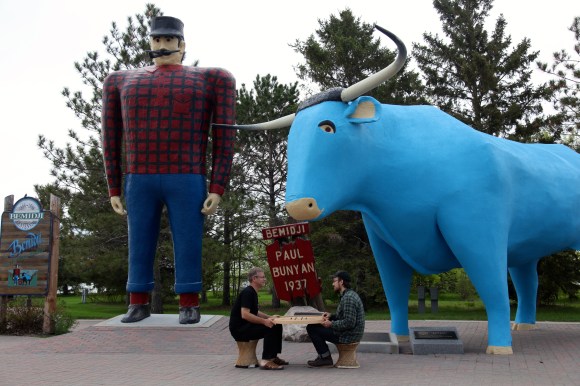
After driving straight through six U.S. states and two Canadian provinces, we pulled into Tavistock, home of the oldest known crokinole board dating back to 1876. During the drive, when our periods of silence (often reaching four or five hours at a time) were broken, we discussed religion in many contexts; traditional theology, silage and dairy production in devout farming lives, and most importantly, righteousness through crokinole techniques. We made our ecclesiastical pilgrimage, fasting from sleep and whole foods in the goal of reuniting westerly disciples with the holy land of immaculate wooden conception. We were pilgrims for the board of life. The home of crokinole was like I had dreamed it would be as a kid of twenty-four years old. An established farming community of dairy producers with a Main Street that boasted a two-decade old Chinese Restaurant, local credit union, and butcher shop. As one might expect, side streets were dotted with various forms of seniors’ homes.
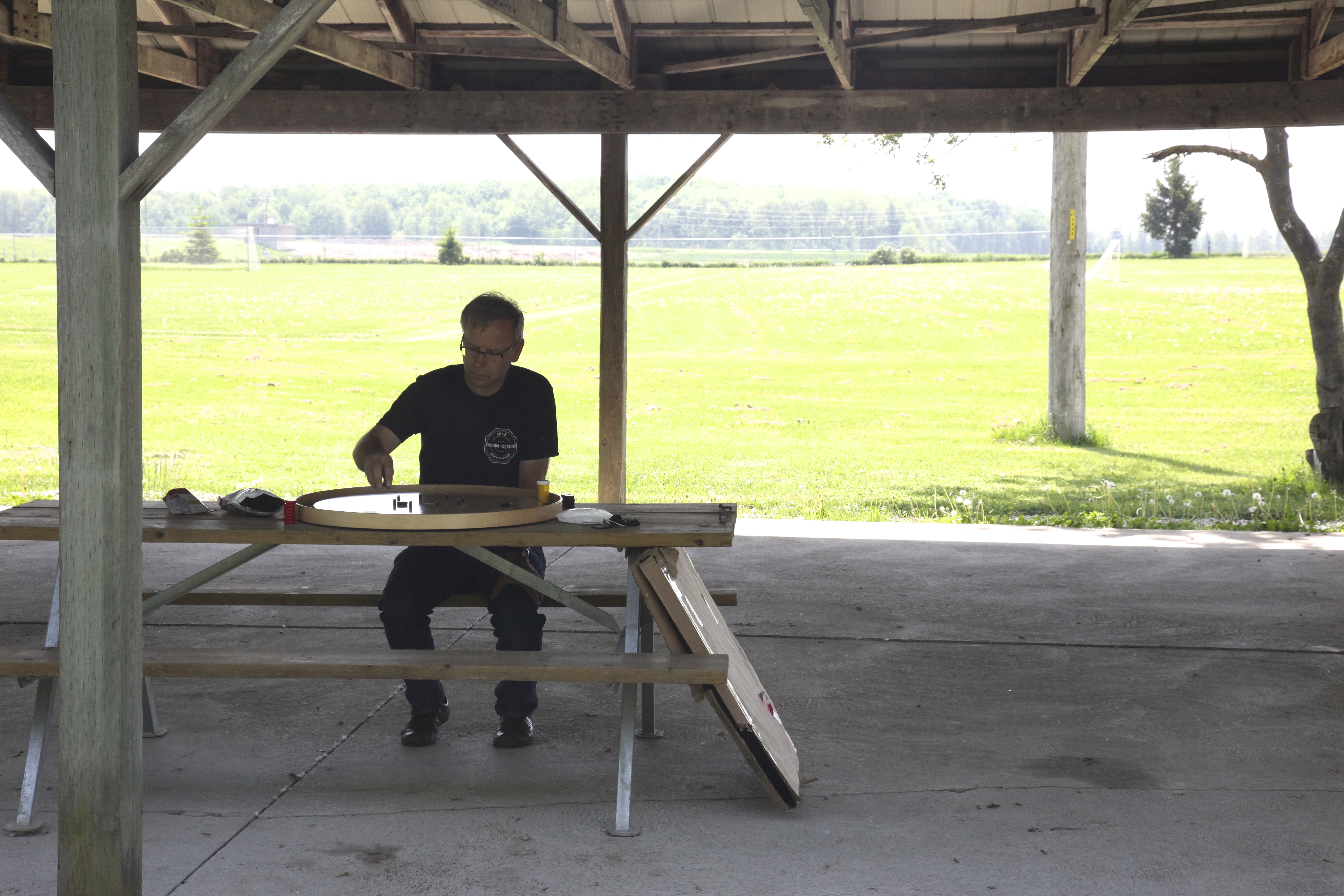
Upon arrival, silence was broken by John Schultz, the bald, wiry, extremely pleasant chairman of the World Croknole Championship, asking, “Are you folks here for the crokinole tournament?” He woke us napping in the park—our first hours of horizontal sleep in two days—and it finally occurred to me what we’d done. We drove twenty-two hours for crokinole. In the same amount of time I could’ve driven to the flawless forests of northern California. I could’ve driven to Nunavut. “Holy shit,” I thought, “I could’ve just travelled an hour and played a game of crokinole with my grandpa.” But instead I drove twenty-two hours to play with all of the grandpas of southern Ontario. John Schultz continued to tell us that other folks drove in from Michigan, New York, Ohio, P.E.I.. We cleaned up, grabbed our board, and began our pre-tournament practice on a picnic table in the shade of Queens Park.
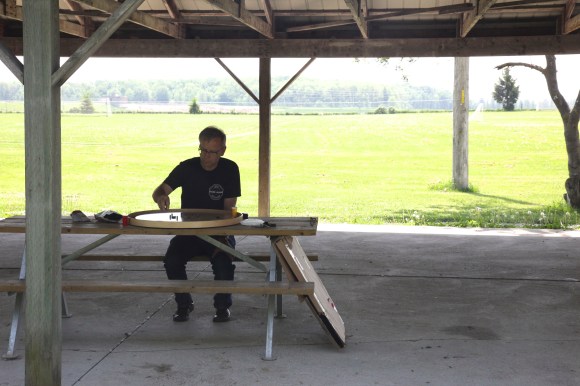
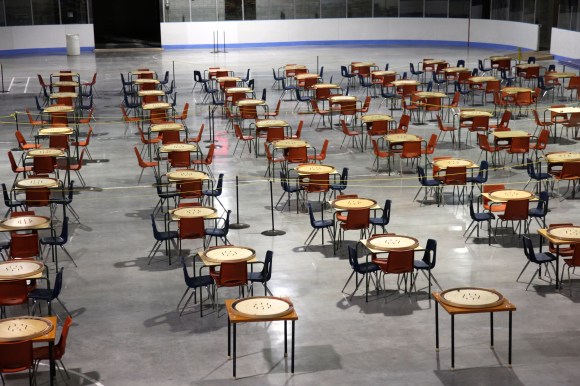
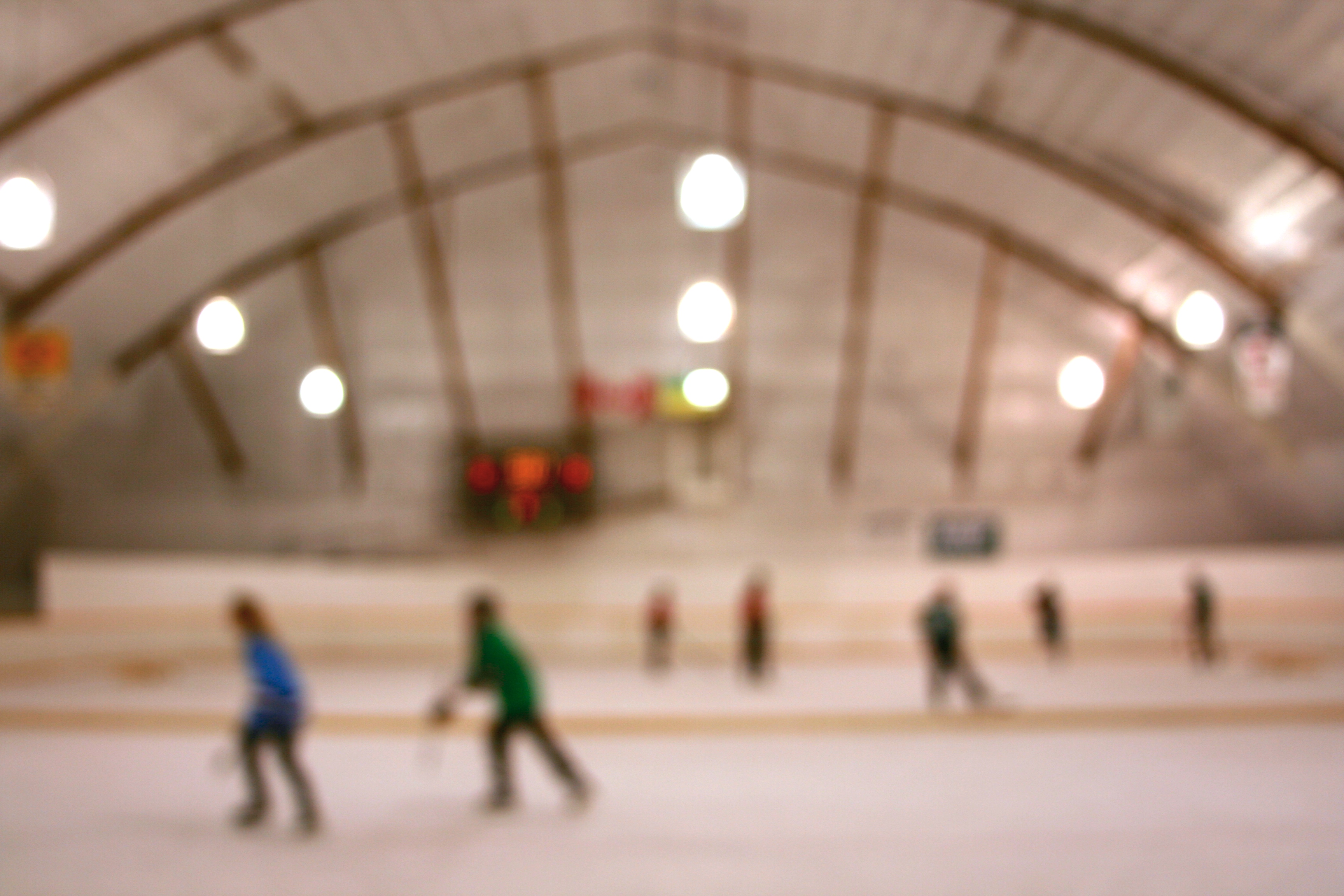
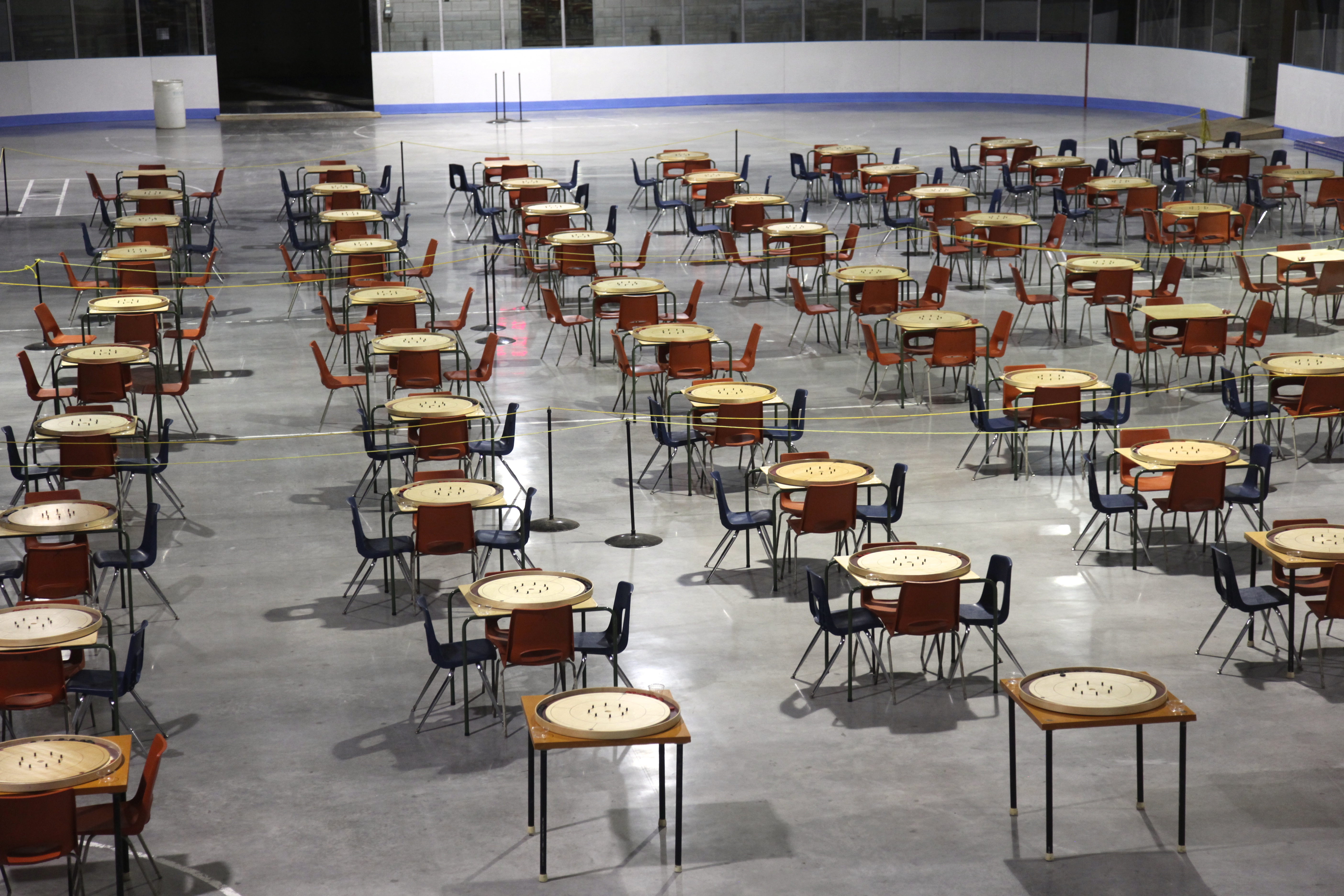
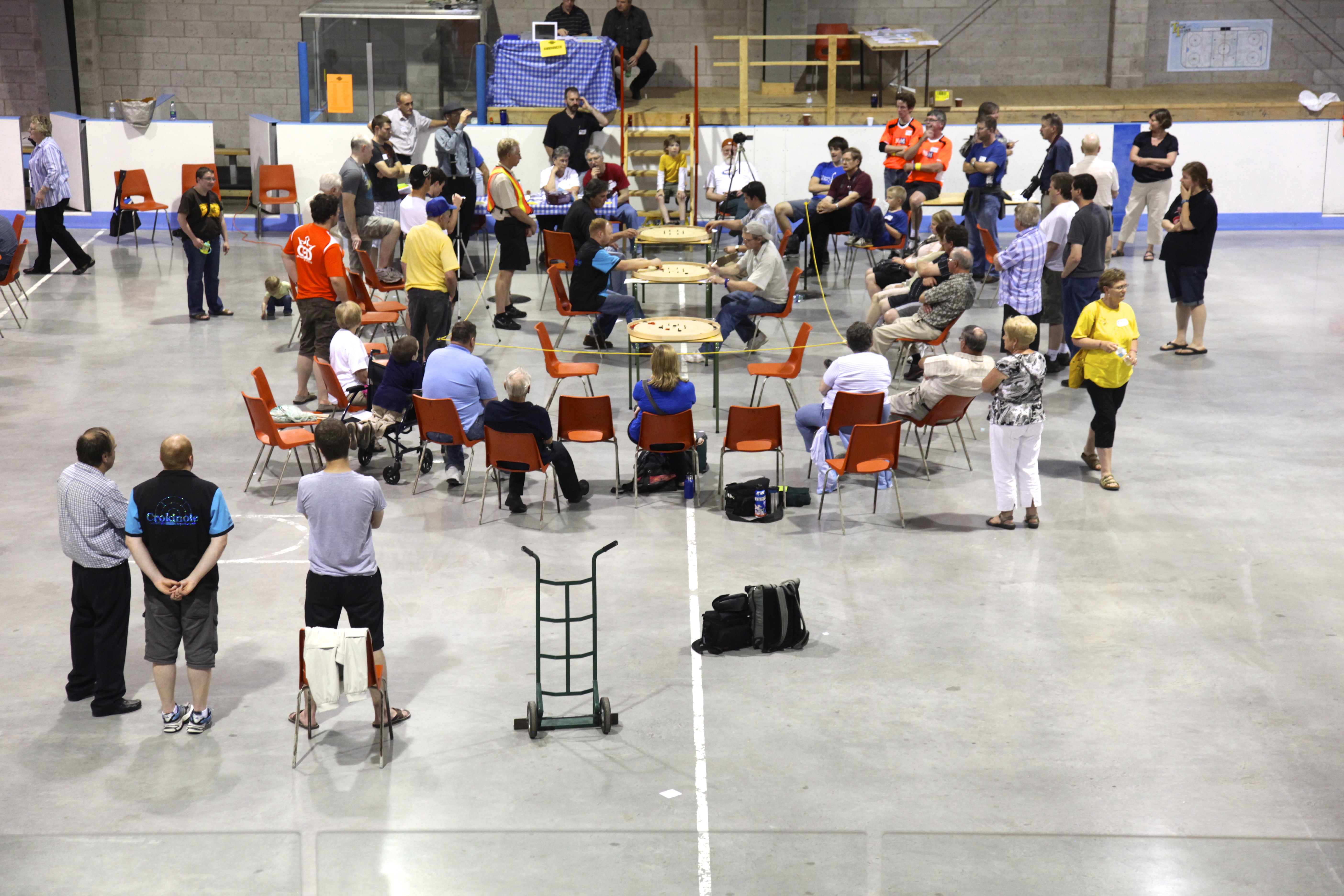
On Saturday morning when I woke up at dawn to practice before competition began at 8:30, the Ontario air was thick. The humidity weighed down the crokinole buttons as if Mother Nature rubbed each one on her sweaty chest. After a breakfast fine-tuned for finger endurance I followed my father into the arena which housed over 64 freshly waxed, previously untouched boards set up in a grid on the concrete slab of the dried up hockey ice, all partitioned by yellow rope. Competitors and spectators in jean shorts and agriculturally branded caps floated around the merchandise on the perimeter of the rink. Those keen on capitalizing on the lucrative crokinole market sold World Championship t-shirts, ballcaps, boards and board accessories. People competed in the skill shot competition and captured photos of the trophies which were handmade for the event (it is difficult to find a golden plastic figurine of a man playing crokinole to fix to the top of a regular trophy). When tournament competition began, over 280 competitors showed their masterly applied-geometry skills and muscle memory. Each competitor sat down at a table with ten strangers for eight minutes at a time until the horn sounded, shaking hands and wishing luck to people they hoped to blank eight points to zero. Saturated in Canadian politeness, if crokinole isn’t a game of true sportsmanship, it isn’t anything at all.
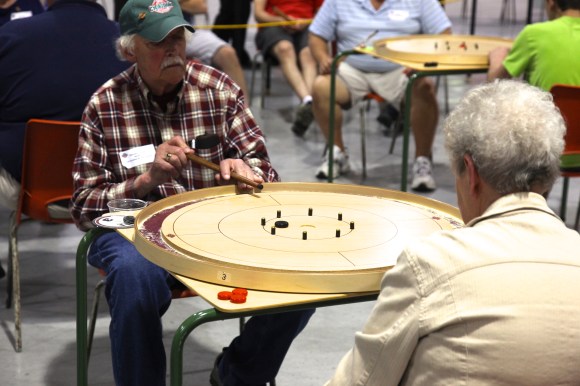
As for the competition, unfortunately the prophesy from aged-competitor Dave Skipper that, “people with beards and moustaches shoot better on these boards,” didn’t prove true. I, one of the few participants with a gnarly beard, didn’t even place in the top half of the draw, and the eventual singles champion, John Conrad, had the hairless face of a teenager, although he was surely approaching his golden years. My father proved to be worthy competition, scaling the ranks of eleventh of 86 participants in the main draw, making the playoff round with the true elites. The final match drew crowds upwards of forty, those who had already sweat through their crokinole team jerseys and sweat bands, groaning and whispering with the final shots of the game. Hands become shaky with such pressure. For one of his final shots, Conrad made an incredible triple take-out. Someone in the crowd said in praise, “I think that was a statement.” In the finals, fathers sat behind the yellow rope, watching sons in competition, offering familial support. My father and I participated in the great paternal experiment that is crokinole.
While discussing board consistency during the final round, a man who placed third in the doubles category, making no excuses, commented: “The heat, the humidity—we have been battling the elements all day long,” as though it were an Ironman competition, which, in a way it was. The oldest participant was 88-years old, and was celebrating his 50th wedding anniversary at the tournament. He had competed in all previous fifteen World Championships that had been held.
If it were a televised event, and if the champions were interviewed and asked to describe their feelings, I imagine that like any other world final, they would stumble and mumble in speechlessness. There is no way to properly explain a world championship of any sport, and it only becomes more grueling when it is a celebration of nearly-perfected obscurity. We travelled knowing full-well that we were participating in an antiquated parlour game that itself was competing against screen-bright technologies for space in the family room. What we didn’t know was that our hands would shake and that we would miss shots from fried nerves in a game usually as relaxing as a free massage. We didn’t know that we’d have to practice for another year to make even a dent in the crokinole kingdom.
Back to the grind. Back to the board.

-
Four Years of Life
I have now been alive for four years. I have learned nothing.
What I have feared when I began writing is potentially coming true. I don’t believe that there is a limit to discovery or knowledge, however there might be a limit to the ways a man can express new knowledge in a certain medium. And although there is no limit to discovery or knowledge, a man can indeed stop learning. I am running out of things to say, because I am only so good at recycling. There are only a few ways to write the same sentence.
There are perhaps two ways to stop gaining knowledge. Either you eventually come to know absolutely everything, or you come to a point where you give up. Each year, once or twice or sometimes thrice, I come to a point where I contemplate giving up. To stop treading, stop kicking, exhale completely, and sink to the bottom. To retain nothing new because it seems that there is no purpose to do so. Birthdays, and Near-Death Birthdays are sometimes the cause. Just another year since I have seemingly learned nothing, and another year where I contemplate giving up, if I haven’t done so already without even knowing it yet.
I still climb rockfaces I know might kill me, which suggests I haven’t given up, because it takes a grand effort to even choose a rockface to climb. I still climb rockfaces, which seems to suggest that I haven’t learnt a damn thing since April 17, 2009. By these very facts, I must hold all the knowledge that exists in the world.
Or my hypothesis is wrong.
I guess I’ll keep writing.
“It’s one of the great fallacies, it seems to me,” said Lee, “that time gives much of anything but years and sadness to a man.”
-Steinbeck, East of Eden, Chapter 30.2, p373



 Balls of Rice