Category: Politics

  • I wasn’t shot dead in the CN Railyard.

    Originally posted December 2015. Updated Feb 9, 2018.

    We sat bored as hell in the dormitory of our Christian high school. Tired of lighting carpet on fire, bored of fist fighting with hockey helmets and gloves in a boy-battle named Cage Rage, weary of quietly playing Nintendo with girls we’d never marry. The week before, a boy had chased a rabbit onto the highway, it got flattened and brought back as a trophy kill. He wanted more blood. We gathered in his dorm room–the home of one of those kids who grew up killing things for fun, the kind of kid who hides a compound bow under his bed–and slipped on camouflage jackets and gloves, orange toques and Santa hats, grabbed the CO2 powered pellet gun built like a rifle, and headed to the train tracks to shoot pigeons. Ten years ago this past December.

    We walked through campus with an uncovered rifle, walked across an empty field, past several blocks of homes, down an alley, four of the dumbest and most innocent church kids there ever were, excited to rid God’s green earth of some of its other dumbest animals. We crossed a hill, maybe hopped a fence, and entered the railyard. We searched for any living thing; rabbits were hiding, squirrels were sleeping, but there were the pigeons, cooing from on high. I raised the gun to my shoulder, aimed to the top of the billboard where they glowed iridescent in the cold grey sky. First shot was low, hit the billboard, an ad for cell phones. Second shot was high, the pellet likely raining down on a passing-by car. Third shot was never taken, we heard a car crawl over the hill near the tracks. Flashing lights on top. Myself and the kid wearing the Santa hat took to run, but were stopped by our more experienced gunmen. Another cop car pulled up from around the gravel access road. From behind us came two cops on foot being pulled by pursuing German Shepherds.

    I wasn’t shot dead in the CN Railyard. Ten years later, my mother does not mourn my death.

    Tamir Rice, 12-year-old kid in Cleveland, Ohio, “whose size made him look much older,” approximately the size of a 17-year-old grade 12 student from a Christian school, was shot dead in his park. A year later, his mother mourns his death and the fact that greater society, the courts included, does not see it as a pervasive problem. Colten Boushie, a 22-year-old kid in smalltown Saskatchewan is shot in the head and the man who admitted he shot him in the head is acquitted.

    * * *

    At one of the two Christmas events I couldn’t avoid, politics came up. I was bureaucratically sorting my RACK-O cards from least to greatest, listening to peoples’ justified disbelief at a gun culture that allows people to be regularly shot down in the streets. Not a mention, save for the flight delay caused by Black Lives Matter protests at an airport, of racial inequalities, radicalization caused by the perpetual war state, the cutting of social programs. Polite Canadians can righteously shake their heads at their southern neighbours about their affinity for deadly weapons, but don’t bother condemning their southern neighbours for racial oppression because they can’t—-both places are equally as guilty and purposefully ignorant.

    Without first hand experience, it may be impossible for those with privilege to fully understand systemic oppression. Systemic, meaning, deeper, more complex, often unnoticeable, traditional ways in which our society and our personal actions, whether we know it or not, play into oppressing a group of people. Systemic, meaning, racism based in systems such as policing, the courts, social services, healthcare that create a culture in which the general populace, who may have nothing to do with these systems themselves, still perpetuate racism through their own action or inaction. To even gain a glimpse of this oppression is done only by building relationship with the person who suffers from its crushing weight, learning about them, until you can clearly say that common understanding and camaraderie is shared.

    The shooting of a Black pre-teen in the midwest, the death of Eric Garner at the hands of police, the Starlight Tours given to Neil Stonechild twenty years ago in Saskatoon, the murder of Colten Boushie, are the culmination, the physical representation, of the systemic racism suffered by people of colour in North America. They are not “perfect storm[s] of human error” or “freak accident[s]” or individual incidents. They are tied so closely together and so closely to the fabric of our colonial society. It is not simply the lack of gun control, but the lack of gun control that rests upon a bed of racism and colonialism. Not just a few bad police officers, bad apples, dealing with a few ‘problematic’ people, but rather a few bad police officers trained and conditioned by the organization meant to uphold the power of the privileged at the expense of the rights of Aboriginal peoples. Systemic.

    Until the privileged come to understand that these attacks that seem (to the unoppressed) isolated and separate, are actually the continuation of a plan of assimilation and extermination that has existed since the inception of the settler state, innocent people will continue to be shot by police officers. And for people to truly come to understand how broad and sweeping the system is, how it permeates the lives of both privileged and oppressed, they will need to learn to grow in community with someone who might not even be aware of all the ways they are being slighted by society. Because before a person can have the will to create change, before they even understand why change is necessary, relationship must be nurtured.

    * * *

    We were told to put the gun on the ground and our hands in the air as the police officer had his hand on his right hip. I shouted that it was just a pellet gun; he repeated his demand. I placed the gun in the snow and we followed the officer’s orders, slowly approaching single file with our hands in the air.

    Our only punishment was standing out in the cold for fifteen minutes with our hands exposed, turning red from winter’s bite. No parents were called. No dorm moms were informed. No one was shot. They even let us take the gun home.

    The “perfect storm of human error” didn’t happen, in my case, for specific reasons. But “the perfect storm of gun-mania and systemic racism” did happen in the case of Tamir Rice, and Colten Boushie. Admitting our faults as a great racist continent isn’t easy, but neither is watching your unarmed son get shot.


    Also read Beyond Bad Apples at Changing Suns Press.
  • Books of the Year: 2017

    If Beale Street Could Talk – James Baldwin

    “Perhaps, as we say in America, I wanted to find myself. This is an interesting phrase, not current as far as I know in the language of any other people, which certainly does not mean what it says but betrays a nagging suspicion that something has been misplaced. I think now that if I had any intimation that the self I was going to find would turn out to be only the same self from which I had spent so much time in flight, I would have stayed at home.”

    -James Baldwin, Giovanni’s Room

    Postcards from the End of America – Linh Dinh

    Simply put, many Americans have become redundant in an economy rigged to serve the biggest banks and corporations. With no one hiring us and our small businesses bankrupted by the behemoths, many of us are forced to beg, peddle, push or steal, though on a scale that’s minuscule compared to what’s practiced by our ruling thugs. As we shove dented cans of irradiated sardines into our Dollar Store underwear, they rob us of our past, present and future.

    -Linh Dinh, Postcards from the End of America, Lower-Class Upper Manhattan, p180

    All Quiet On The Western Front – Erich Maria Remarque

    The Wind Up Bird Chronicle – Haruki Murakami

    Angels – Denis Johnson

    This Accident of Being Lost – Leanne Simpson

    Requiem for the American Dream – Noam Chomsky

    The Lathe of Heaven – Ursula K. Le Guin

    Going to Meet the Man – James Baldwin

    Other Works of Note
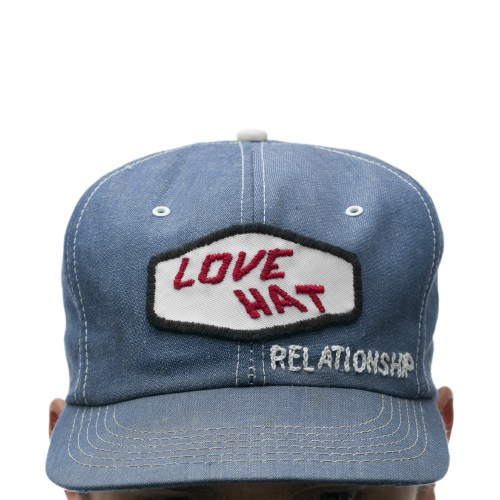
    A Love Hat Relationship
    Book One
    Tour Book

  • Fuck Art, man

    Sometimes they say that I work in the Arts. Sometimes they call it the industry. I tend to believe I work in the business of happiness; making people happy by selling them Art pressed into wax and Art pressed onto cotton, manufactured by people who are unhappy, someone’s boot pressed in the middle of their back, picking cotton, weaving cotton, sewing cotton, inhaling cotton, shipping cotton. And maybe wax.

    Happiness follows the law of conservation of mass. Happiness cannot be created or destroyed. The total mass of the reactants equals the total mass of the products.

    Ice to water, water to steam.

    Former-happiness to cotton. Cotton to t-shirt. T-shirt to Art. Art to happiness.

    Art doesn’t walk around town handing out twenty-dollar bills or cab vouchers or new rental lease agreements. Art doesn’t have its lifeguard safety—it doesn’t save people who are already drowning. Art is like whiskey, it makes you feel warm even though you’re losing your leg to the cold.

    Where was Art when your friend was evicted by Regina Housing Authority and slept outside for a month and died in his friend’s kitchen? Had we finally convinced him to draw a picture for the Free Press, would Art have saved him?

    Where was Art when your wheelchair-bound friend kept getting his cigarettes stolen by his brother who could have been painting miraculous animal scenes and selling prints but instead stole blind people’s cell phones to sell for crystal meth?

    Art was in an office building, denying grants. Art was at a wine-and-cheese opening wearing a well-fitting shirt.

    Fuck Art, man. Fuck the fact that this piece of prose is (debatably) a piece of Art.

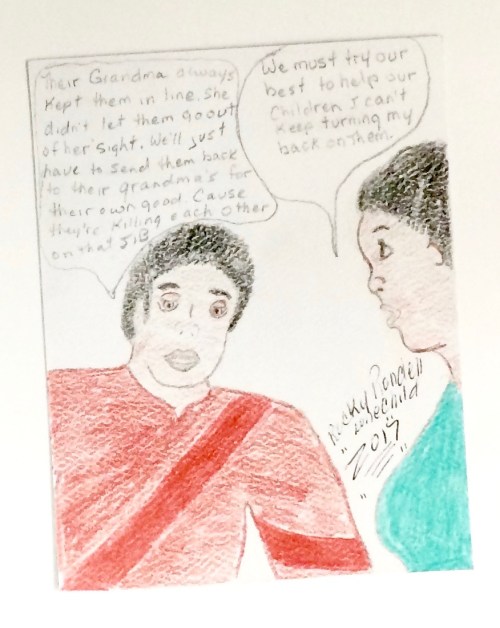
    Rocky sits in the the empty coffee room of a fading drop-in centre drawing portraits of people who may or may not exist, to give away to the first person she knows will praise her for it. Rocky draws because it’s the only thing that can help her cope with the fact that everyone she knows is dying in front of her.
    Fred.
    Her aunt from Cote.
    Hilliard, found frozen outside.
    All in a week. She draws because what the hell else can we do?

    Fuck Art.

    That is, unless it’s used for its one and only true purpose, as with Rocky, as the antidote in a place dripping in poison.

  • Books for People Without Homes

    “You in that house yet?”

    “Which one?”

    “The one they were gonna work on.”

    “Oh yeah, I’m in there. They’re not working on it yet.”

    Click the computer a few times. Library worker stocks books. The Dewey Decimal System leaves no book without a home. They don’t lose books. Have you ever heard of a library losing a book? The man behind me mumbles, “Fuck sakes.”

    “Yeah, I was gonna look into that Phoenix Group.”

    “Oh, yeah.”

    “Yeah, but I’d be 80th on the wait list.”

    “You been to SWAP? I had a few buddies who went through Souls who went there. They didn’t even have to go to Social. SWAP did it all for them.”

    “No where’s it? Albert? Like by the McDonalds? Ok. No, Detox told me that Phoenix would do all the Social Assistance stuff for you, you wouldn’t even have to talk to them, which is good, since Social is so useless nowadays. But then you’re 80th on the waitlist.” 

    Spend fifteen hours in two days clicking the mouse around white farmer caps, calling people on farms asking if they are willing to be in a book about hats. Write short blurbs about hats and how they relate to institutional racism and amoral government. Brainstorm where you can donate the theoretical money from selling unsellable hat books to help alleviate the housing crisis. Remember that making books doesn’t house people and raising awareness is masturbation.

    “Fuck sakes,” the man behind me mumbles. Can’t find a house. Housing with obstacles. Maybe there’s a book about that. Filed under the Dewey Decimal System:

    How To Find an Apartment When The World Hates You and Denies Your Existence.
    821.2219 HARPAUER

    A Complete Guide to Budgeting for People Whose Rent is $400 More Than Their Cheque.
    821.2218 FOUGERE

    LOVE YOURSELF: Family Self-Esteem When The State Doesn’t Think Your Uncle Deserves A Funeral
    821.2217 BEAUDRY-MILLER


  • His Civil Worship

    Another native German Heinrich, Heinrich Böll, a great writer, and I became friends even though we had once been corporals in opposing armies. I asked him once what he believed to be the basic flaw in the character of Germans, and he replied “obedience.” When I consider the ghastly orders obeyed by underlings of Columbus, or of Aztec priests supervising human sacrifices, or of senile Chinese bureaucrats wishing to silence unarmed, peaceful protesters in Tiananmen Square only three years ago as I write, I have to wonder if obedience isn’t the basic flaw in most of humankind.

    -Vonnegut, Sucker’s Portfolio, Episode Seven – The Last Tasmanian, p132

    Hey Michael, I’m sorry that I spray painted your campaign sign in 2012. I mean, you still won. Twice even! I was young, angry. Now I’m slightly less young, still angry, but know better than to spray paint things on property that doesn’t belong to me, because I know you believe in the concept of property.

    But, really, man, (I can call you man, right? We’re cool?) people who don’t believe in civil disobedience? They’re usually evil. Like dictator evil. Like Stalin evil. Either that, or they are so blinded by privilege that they couldn’t possibly understand that laws aren’t always fair. (I won’t get into the fact that laws themselves are made to uphold privilege for people who hold positions of power, like say, Mayor. We’ll get there in our relationship someday.)

    And I don’t think you’re evil. Not yet, anyway.

    But please don’t let my minor experimentation in vandalism sour you from civil disobedience altogether! It can be a fun act of friendship and community! Like setting up tents and having a fake campfire and making signs asking for donuts outside of the INAC building to try and help end a little thing called ‘genocide’ in Canada. Sure, Colonialism No More wasn’t illegal, but it didn’t stop your political counterparts from trying to come up with ways to make it so. I know you believe in the marvels of bureaucracy, but sometimes breaking the rules is the only way to get things done.

    Civil disobedience is important. It can help people who have less rights, thanks to the laws passed in the Henry Baker Hall, to gain rights. You wouldn’t go as far to say that the segregation laws that Rosa Parks helped end for Blacks in America is illegitimate because she did it in an unlawful way, would you? Wait, so, you strictly opposed even the faintest suggestion that Regina Police Service might have issues with discrimination and racism? Well, then, maybe you wouldn’t like Rosa Parks.

    I understand that as the Chair of the Board of Police Commissioners, you worry about people breaking the law. Because if regular citizens started breaking the law to stop injustice, then people like Constable Powers wouldn’t be able to break the law and get away with it too, and then, really, no one would be safe.

    In a recent speech, Sylvia McAdam (you may have heard of her, but then again, maybe not), said to look up the legal connotations of the word ‘acquiescence‘. I’d heard the word before, but didn’t know what it meant.

    Wikipedia: In law, acquiescence occurs when a person knowingly stands by without raising any objection to the infringement of their rights, while someone else unknowingly and without malice aforethought makes a claim on their rights.

    In Sylvia’s case, sometimes ‘raising objection‘ means to actually lay on the road next to her land to stop forestry companies from logging and destroying the place where her people are buried. Because sometimes the lawmakers won’t listen, because the laws are made for the loggers. And if she didn’t stand up for her land rights, they would become someone elses’. If the place where your family was buried, or where your family played golf, or where your family played drums, was going to get torn up and ripped down, would you lay down in the road and stop them, or would you just write a letter to the Mayor?

    Mr. Mayor, sometimes laws aren’t right, because sometimes (tough pill to swallow) lawmakers aren’t perfect. And sometimes, even with the aid of dollar-store posterboard and a megaphone right outside of your office on the 23rd (or whatever the hell) floor, you still can’t hear people.

    So to say that you disagree with civil disobedience, means that you disagree with all the things that civil disobedience has accomplished. And if that’s the case, I worry for the state of our city, specifically for those who don’t benefit from the laws that you feel are so damn just.

    Please reconsider.

  • Up-and-Coming

    Three blocks from the venue, down an industrial street in Denver like that in any North American city that boomed in the 1950s, was a small store inside of repurposed shipping containers that sold US-made backpacks, outerwear, and slacks. The store was clean and simple and catered to the young outdoorsy types who live inside but are able to sleep in tents in exotic locations outside.

    “We were one of the first businesses in this part of town,” said the shopkeeper sitting bored behind a handmade counter, hair messily gathered in a bun on the top of her head like she had just crawled out of a tent in the Rockies that surrounded her city. “Since then all sorts of businesses have opened here, which is too bad, it used to be a cheap part of town. Now there’s a luxury hotel going up just up Larimer.” The woman expresses her displeasure just as I would. I agreed as I tried on a pair of outerwear pants behind the changing curtain. Their shop and brand are participating in making the neighbourhood more expensive by selling $150USD pants, but they are at least trying to create a manufacturing industry by making their products in the USA. I left without buying pants, wondering where the nearest goodwill was.

    The next day, the venue was plopped in the same part of town, only in a city that was 500 miles away, a state and a half to the east. After load-in and soundcheck, the soundman asked “Where’d you go for food? The burrito place? How was it? I heard it wasn’t that good. Yeah, this was the part of town no one would come, until my boss opened this bar and the other one, we started booking shows here, and then other businesses started coming too. It was kinda the bad part of town, now it’s the up-and-coming part of town.” At the expensive coffee joint across from the bar arcade, next to the burrito place, they were giving out a free, one-page newspaper/zine/leaflet. In it read,

    “Most American cities are run by real estate interests… In Omaha, the tactic for encouraging gentrification is Tax Increment Financing or TIF. TIF is a way for cities to return tax money to developers as an incentive to put up projects that the city wants (and the public makes up the difference). Unfortunately, no provision is made for the people who used to live in the cheap housing turned into gentrified apartments. The former residents are simply scattered to the four winds. Surprised by ‘shots fired’ near 108th and Maple? This is your City gentrification policy in action.”

    A similar but more developed street newspaper in Seattle uses the G-word, gentrification, describing places like Africatown in Seattle being dismembered, breaking up the “home and haven for Seattle’s Black families and businesses”, and highlighting stories of people failing to maintain housing in a rapid-rehousing program because of the recent inflation in costs of rent. Large newspapers will only use the G-word when describing vandals in Montreal or Vancouver who are terrorizing business owners, as business is the uncriticizable holy grail of progress.

    I am fortunate to be able to tour with world-class musicians, but each time I’m on the road I wonder how long such jobs will exist. How long will I be paid to burn fuel and watch music in ‘up-and-coming’ parts of American cities, while around the block, that neighbourhood’s previous inhabitants are clamouring to find shelter under a bridge or in a condemned building. I do it because there’s something in music and creation that is able to be unpolluted by corporate greed, though most times it has already been bought and sold.

    When people ask what I got to see this trip, Linh Dinh answers for me in his book, Postcards from the End of America, in which he visits communities across the United States left with little or no economy:

    You can’t really see a city or town from a motorized anything, so if you claim to have driven through Los Angeles, for example, you haven’t seen it. The speed and protection of a car prevents you from being anywhere except inside your car, with what’s outside rushing by so fast that each face, tree, and building is rudely dismissed by the next, next and next…Like television, the private automobile was invented to wean us off our own humanity. From each, we’ve learned how to amp up our impatience and indifference towards everything, and with life itself.


    After tour ends I fly home to an ailing Saskatchewan. I’d heard of the government cuts while in San Francisco, when a friend texted saying WHAT. THE. FUCK. with a link to an article about the shutting down of the province-owned small town transportation and parcel shipping company. Now home, walking through the downtown, worried citizens are passing colourful clipboards around, asking passers-by to sign one of the multitudes of petitions that are circulating to Save Our Libraries, Save our Bus System, Save our Schools. I sign them all, knowing full well that no petition will be worth the millions of dollars that the government squandered on stadiums and tax cuts on resource extraction companies. The angry protests and province-wide campaigns might get them to preserve something, but the effectiveness of these actions will only go so far if we continue to work within the system that props up corporate interest over that of the public. Though it plays into the hands of the fearmongering government and high income class, one can see why smashing windows in Montreal seems more effective.

    Government MLAs show their responsibility, boasting their 3.5% paycuts, which to them means 3.5% less income to spend on boats and cottages and home renos and filet mignon. The paycuts they make to those on social assistance, the paycuts they make to those once employed by the rural transportation system, the cuts they make to the libraries, all mean that thousands of low income individuals won’t have food, shelter, a way to travel for medical treatment, books, and significantly more.

    Several years ago, after seeing Chris Hedges speak at the University, I worried that Saskatchewan was the next sacrifice zone—the places that are abandoned by industry, left in disrepair and a humiliating culture of dependency after being used and left behind because of their lack of monetary worth. This could be the beginning of that reality.

    It starts with the desperate government selling its struggling assets to the highest bidder, then selling its most profitable assets. They begin begging oil companies to relocate to the province to help the crumbling economy, start giving public land to large corporate bidders. At this point, entire cities and provinces will be bloated with corporate-controlled land and buildings, and towns end up, in a way, like the middle-class urban centres of post-manufacturing North American cities, where no one can afford to pay rent. Eventually, when the government isn’t coddling big business enough, they’ll pack up and move to find a different government who will subsidize their existence. Thirty years later, when our industries have died and all that’s left is cheap bars and empty buildings, businesses that pander to middle class tastes will further move into parts of town with abandoned buildings and cheap rent and begin the process of displacement of those marginalized by the loss of industry, struggling to survive in the older neighbourhoods. We are no better than the economic destruction seen in the United States, we are just a generation behind.

    All that will help in the midst of a breakdown of free, communal places of existence and of the breakdown of social programs, is the creation and maintaining of communities that support one another and support the other, the different communities who are similarly affected. I am the middle class that is being pandered to, and while being in these places, eating their burritos, buying their pants, is not inherently bad, it makes it all the more imperative to support and participate in the communities that are contrary to austerity. These communities—social groups, churches, activist collectives, sports teams, artist groups, musicians—must band together to build movements that support the racialized, marginalized, the poor, Indigenous, immigrant communities, who are most harshly affected by public cuts and an economy sucked dry.

    Linh Dinh, states the obvious:

    For any community to be healthy, local initiatives must be encouraged, nurtured and protected, so let’s reclaim our home turf, reestablish the common, and, in the process, regain our collective sanity and dignity.

  • Oppression is Reality

    2016-11-08-16-46-49

    There’s this man that sits in the front left seat at the movie theatre and he’s always there. He has with him a copy of the free newspaper or a novel and is only ever there by himself. When something he deems comical happens in the film, he lets out a laugh like you’d hear in a country western movie, a croak of a chuckle. He sits through the credits and probably doesn’t drive home because he wears a scarf to keep him warm when he walks. I leave the theatre and I expect to see him there again when I return, waiting in the front left seat.

    My stomach flipped and my feet went numb and I couldn’t stop myself from desperately screaming “Shut up!” at the MC on stage. He wore a pretend cowboy hat and hoodie with an anarchist circle-A on the front. I’m not usually the heckler.

    “Did anyone watch the news the last two days?” he asked the audience earlier, just before I shouted him off-stage. “I hear they’ve got a new president down there. It may seem bad, but I guarantee you, because of it, we are going to have four years of the best punk music that you’ve ever heard in your lives!” he said excitedly. Punk music is an industry, apparently, like the weapons industry, agri-business, pharmaceuticals, private prisons–it profits off the misery of others. So I booed him. I fucking booed him and he got off stage to let the band play. Protest works. The opening band got on stage and sang ten songs exclusively about baseball, a man dancing around in a jockstrap, his exposed ass jiggling on-stage.

    I gave up. Halfway through the baseball band’s set, I walked to the coat rack next to the arcade game to hang up my jacket. The man from the movies sat at the bar of the music venue reading a book, sipping on a non-alcoholic beverage. He lifted his head once or twice during a song to see what was going on onstage. I don’t see him leave and I don’t see him stay.

    He isn’t real. I’m convinced. He appears and disappears like a phantom or a projection or a conscience or a prophecy. A wake-up call that I haven’t yet woke up. Maybe the man on stage wasn’t real either. His hat was far too ridiculous and his hoodie far too ironic and his speech far too annoying to be a real person. Maybe he was a construct of my disillusionment in the so-called progressive, socially-minded left, a culmination of that and the realization that aggressive music rooted in anti-establishment values is long dead. I feel as though I’m dreaming all of the time.

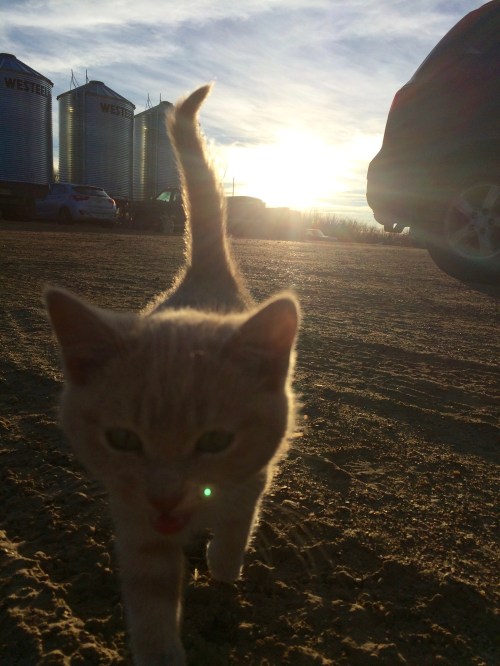
    The farm had five kittens. They wrestled, kneaded the dog’s fur, climbed trees, licked hands, did somersaults. Any spare chance between chores or before coming in for lunch, I played with them. I picked one up and held it and pet it until it purred or until it jumped out of my hands onto the gravel driveway. The cats registered in me no joy. I expected to have this feeling where my chest flitted and my body felt light, but that never came, even when they gently chewed on my finger or mewed on my shoulder. Like they were an emotionless dream, a non-reality.

    After the week on the farm when I end up in the same, unchanged, cell-like apartment after playing with kittens at sunset on a cattle-ranch in the hills, after travelling the world with a successful musical act, after camping alone in the woods for a week–when I end up lonely with a sore throat in my empty apartment, I can’t help but wonder how those things could possibly have actually happened.

    I want to ask friends if we actually went camping in the woods, if we actually kissed, if those kittens were actually purring, but their responses would be unimportant. If you ask someone in a dream if you’re dreaming, they have no existential obligation to say yes.

    I woke up in the basement of the farmhouse, maplebugs crawling on the sheets, American flags attached to a latch-hook rug of a First Nations man in a headdress on the wall. This can’t be real either, I figured. I didn’t know what happened the night before. I didn’t know because I went to sleep before Trump’s acceptance speech. That it happened when I was dreaming dystopian post-election dreams didn’t help me when I woke up wondering if it was reality that a man endorsed by the KKK was the ruler of the ‘free world’. It’s not that I couldn’t believe that there were enough people in one country that held his same values, I’ve met enough people in my life to know that it is more than possible. I went upstairs and Fox News confirmed what had happened. I’m still asleep, I figured.

    Intellectuals such as Chomsky and Hedges and Nader predicted it five and ten years ago. They saw a population of working class whites abandoned by liberal governments selling their privacy, their healthcare, their jobs to corporations, leaving a political climate ripe for fascist rulers. Prophesy doesn’t help ground me in reality, it simply makes it more dream-like.

    As I struggle in my own crisis of absolute reality, women, the LGBTQ community, First Nations, Muslims, Blacks, Hispanics shout to me to affirm that it is indeed reality. Dakota Access Pipeline water protectors shout at the world for support. It is their reality. Reality hits; just because it doesn’t affect a person of privilege doesn’t make it not real. The ‘it doesn’t really affect me’ mentality is rooted in privilege and denies humanity to those who it does affect. If this election doesn’t affect you, if this pipeline doesn’t affect you, meet someone that racism does affect in your own community, and then instantly, it does.

    The ‘unaffected’ non-American struggling with the facts of our new-found political situation, struggling with the idea of a race war between our next-door-neighbours, need to show support in ways more than just internet solidarity. In ways more than writing blogs, stories, songs, tweets. We can learn if our bank supports and funds oil pipelines and change to a new bank. We can boo Trudeau, the neo-liberal asshole in the ridiculous hat, off the fucking stage. If we sit and let him talk, he’ll be up there for hours, masturbating to the sound of his own voice, until we all realize that we are subject to more than just an unfortunate exchange rate when we want to holiday south, but to the inconceivable reality of facist rule.

    The man in the movie theatre isn’t real. He is a delusion caused by stress and anxiety and depression and terrifying elections and the feeling of being completely helpless. Or he is real and he is now sitting at home with purring cats watching the latest election news. I won’t know either way until I go up to him and ask him what he thought of the movie. The MC on the stage isn’t real until he beats the shit out of me for heckling him. The kittens aren’t real until one of them lives in my apartment and scratches my leg. The only way these things become reality is if we allow them into our lives. Oppression isn’t our reality until someone we love has been oppressed. When this happens we can begin to relate with people we have never met who are calling for help to be saved from the hands of those in power.

    This becomes our reality when we share in the oppression of our neighbour, and when it becomes our reality, when someone we love is oppressed, we will have no option but to act.


  • Lyrics of the Month: September 2016

    Stumbling drunk off a bus downtown
    You’ve got it bad for the system
    ‘Cause you know it let you down
    You see the marks on the whores
    And the dimes they lent you
    And your paranoia soars
    On the wings of your dementia

    Without a system that compels
    The growth of human compassion
    Its a face that will never change
    Nobody’s well when even one soul suffers
    We’re bound by circumstances
    We can’t dissarrange
    Does shame prevent you
    From engaging in the indigents struggle

    Just filling up a vacancy
    With nothing new to live for
    When I was young and naive
    I believed I could be so much more
    Out of touch with a world
    That never cared or knew me
    More dead than alive
    when you stare right through me

    Its a face that will never, never change
    never change
    You could be the one
    With your hand held out

    Good Riddance, Bound By Ties of Blood and Affection, Shame, Rights & Privilege

  • Ten Years

    IMG_3007

    It is ten years to the day that I started writing Balls of Rice.

    If you read from the painfully embarassing first post, to the lost and meandering most recent post, you’d see how I went from proud flag-loving Canadian to dissident anarchist-in-training. You can see a public journal of mental health. Ten years later I still don’t know why I write, still don’t know what I’m doing with my life, still eating peanut butter and banana sandwiches for supper. All I know is that Balls of Rice has both saved my life and ruined it.

    Naturally, the only posts worth reading were written in the last four years. The six years before that was trial and error, with more error than anything. These days there is less trial and about the same amount of error. The list below is not a list of the best writings, because reading over every single post could only end in crushing depression. But these ones are alright, I think.

    Thanks to whoever has read this in the past decade for the encouragement. If it weren’t for you, I’d probably be a successful engineer by now. Instead I’m a squatter in the back of a pizzeria.

    Thanks for still reading, mom and dad. Oh you stopped reading it in 2012?

    Yeah. Me too.


    Notable Posts:

    Realistic Ideas – August 30, 2012

    Losing Faith – December 2, 2012

    Cheap Attempts at Warping History – April 2, 2013

    Dear Mouse, – September 17, 2014

    I wasn’t shot dead in the CN Railyard – December 29, 2015

    Still don’t know – July 26, 2016

  • Still don’t know.

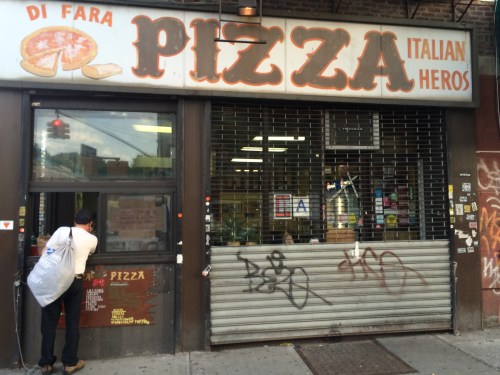
    Di Fara Pizza

    A man walks down a dark Brooklyn side street with his pants at his ankles, genitals flailing. I am looking for pizza. Legitimate conerns are raised about that man getting shot by police but we push on to get some garlic knots at Ganni’s at midnight.

    The Republican convention wraps up and everyone I know, including myself, fears the next four years, but knows full well they’ll survive it. The man walking down the Brooklyn side street, the newly arrived Syrian refugees, the Central American blamed with stealing American jobs, don’t have the privilege of knowing the same thing. In Hedges’ 2010 book Death of the Liberal Class, Chomsky prophesies of a population that seeks out fascism because of a series of politicians beforehand who have sold the rights of the population to corporate power. All they need, he says, is a charismatic leader who tells it like it is. And now he warns this.


    “How much is this one?” I ask.

    “Which one?” the shopkeep asks.

    “The all black one with gold numbers.”

    “$10.” He pulls it out, puts it on my wrist, it fits and feels as though I haven’t wore a watch in fifteen years, which I haven’t.

    “Great.” I place $10 on the table.

    “This one is $15,” he says. I place five more dollar bills on the table and leave, feeling as though I have paid the 50% tourist tax necessary to create a balance in the inequality of wealth that I have benefited from my entire life. The tourist tax necessary to quell my own personal guilt for existing in a marketplace and quitting my community job to travel the world for free. The watch looks great and hasn’t died yet. It fits oddly on my bulging ulna bone.

    I finish my $9 juice and sit on a bench, calling my credit union and credit card company to tell them that I am in fact in the US and that no, my cards have not been compromised, and that yes, I’d like to withdraw money from my accounts so I can spend more money on American juice.

    I loosen the watch strap one notch to relieve the sweat that accumulates under it in the New York humidity in what will likely be the 15th consecutive hottest month on record. I bought a watch so I could avoid pulling my phone out of my pocket so I could avoid wrecking my pants pockets so I could avoid buying new pants so I could avoid buying pants from a hellish factory in south east asia. And so I could avoid using my phone at all. My vain attempts at personal change are conscience clearing but not effective. I still don’t know how to live a life that affects change or isn’t dripping in privilege. You think by 27.667 years of life you’d know everything there is to know in the world.


Is this your new site? Log in to activate admin features and dismiss this message
Log In