Category: Non-University

  • The Carmichael Free Press

    This originally appeared at CarmichaelOutreach.ca.

    Carmichael Free Press copy2
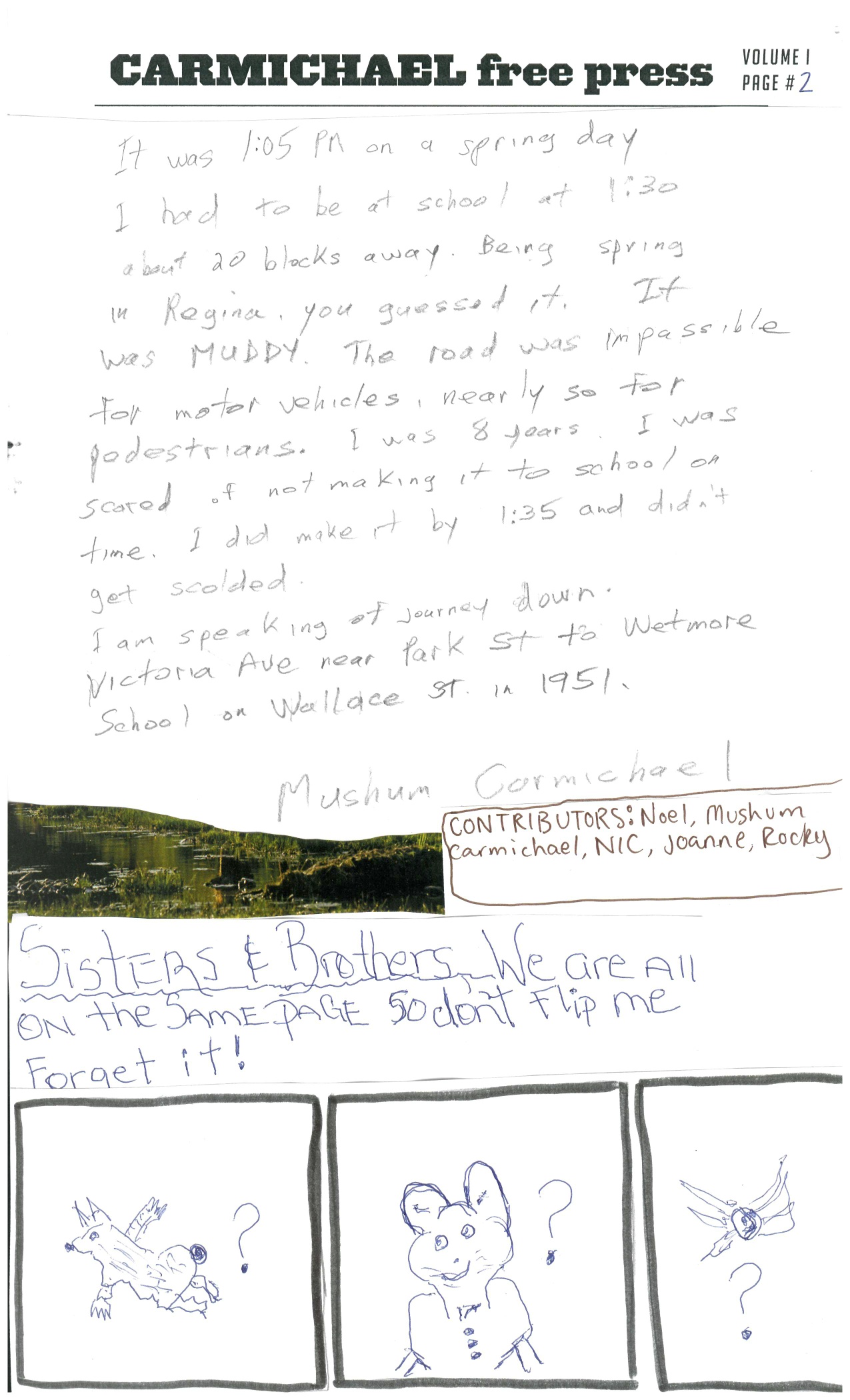
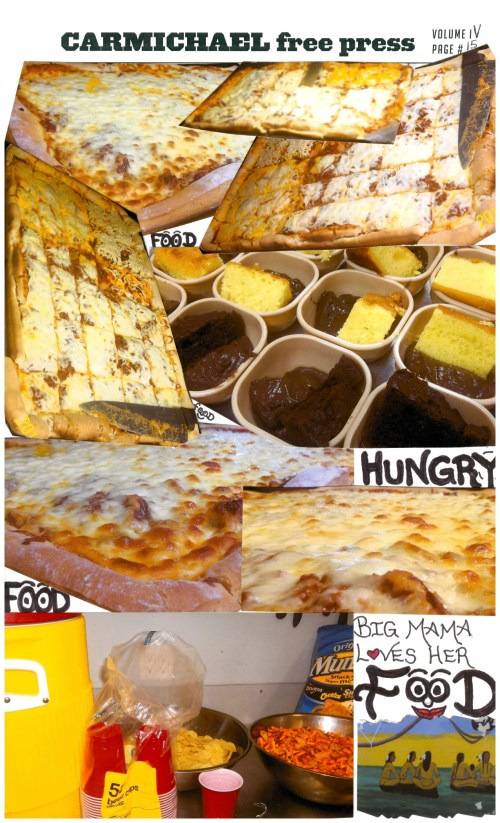
    Noel, Rocky, Mike and others sat in the coffee room on a Thursday afternoon and asked what was going on for programming that afternoon. “Art Class!” I proclaimed on my way downstairs. I brought up the box of scrapbooking supplies that former gourmet chef and art mastermind Mike Wysminity paid for with money he raised himself by selling tomato plants at the Farmers Market in pots hand-painted by Carmichael art participants.

    I tossed markers, fancy-edged scissors, stickers, moon-shaped hole punches on the table and people started creating. Noel wrote an inspirational quote and drew a cartoon. Mike wrote a poem. Lisa wrote a note to her son under a picture of him taken from a previous Carmichael Hockey Day. Brian wrote a story. Then staff members cut them out, organized them, and pasted them on the template, made copies, and printed them for the masses.

    The Carmichael Free Press is a grassroots publication on it’s fourth edition so far—a zine style scrapbooking newspaper that anyone can contribute to. Not topical, always different, the Free Press is a creative home for real, not-pretentious, unknown writers, artists, painters, comics, mothers, children, and more, not only to produce something they are interested in—they are proud of, that makes them laugh—but to have it shared with their group of friends, the Carmichael staff, and the greater community.

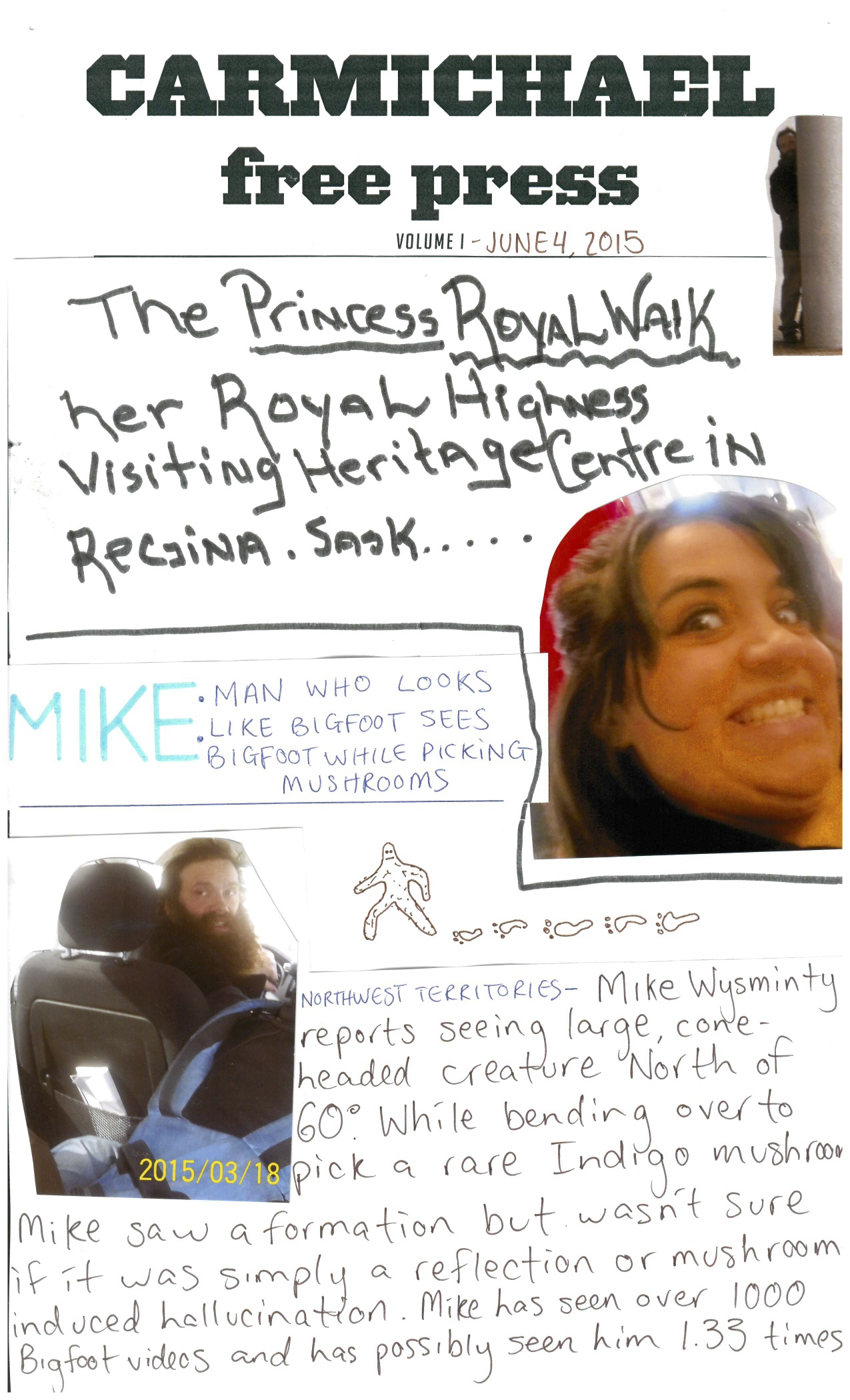
    The first ever headline of the Carmichael Free Press was borrowed from a photograph from a previous Carmichael photography class partnered with the Heritage Community Association and Sask Arts Board.

    “Here you go!” he said, as he passed his page to me with the inevitable nervous feeling of sharing something you just created. The headline read, “The Princess Royal Walk – Her Royal Highness Visiting Heritage Centre in Regina Sask…..” with an up-close picture of a loyal volunteer. Everyone in the room laughed at the joke. Real news be damned, street news is what matters. The experiences of people in your neighbourhood who you have never met are what truly matter, not the business interests of private national media. Hailed by its creators as “The most important newspaper in Saskatchewan,” the Free Press begins its climb to the top.

    Thursday afternoon Art Class at Carmichael has evolved as necessary from painting to drawing to scrapbooking to newspaper-making to who-knows-what-next, depending on interest, on funding, and on person skills of the facilitator. The informality and drop-in style of the Art Class is what makes it a success. Peter walked into the coffee room, saw his friend sitting at the table, saw markers, scissors, empty pages of the Carmichael Free Press, and sat down for ten minutes, drew a remarkable drawing of a pipe with the smoke forming a buffalo, eagle, bear. He thanked us for the time and headed on his way.

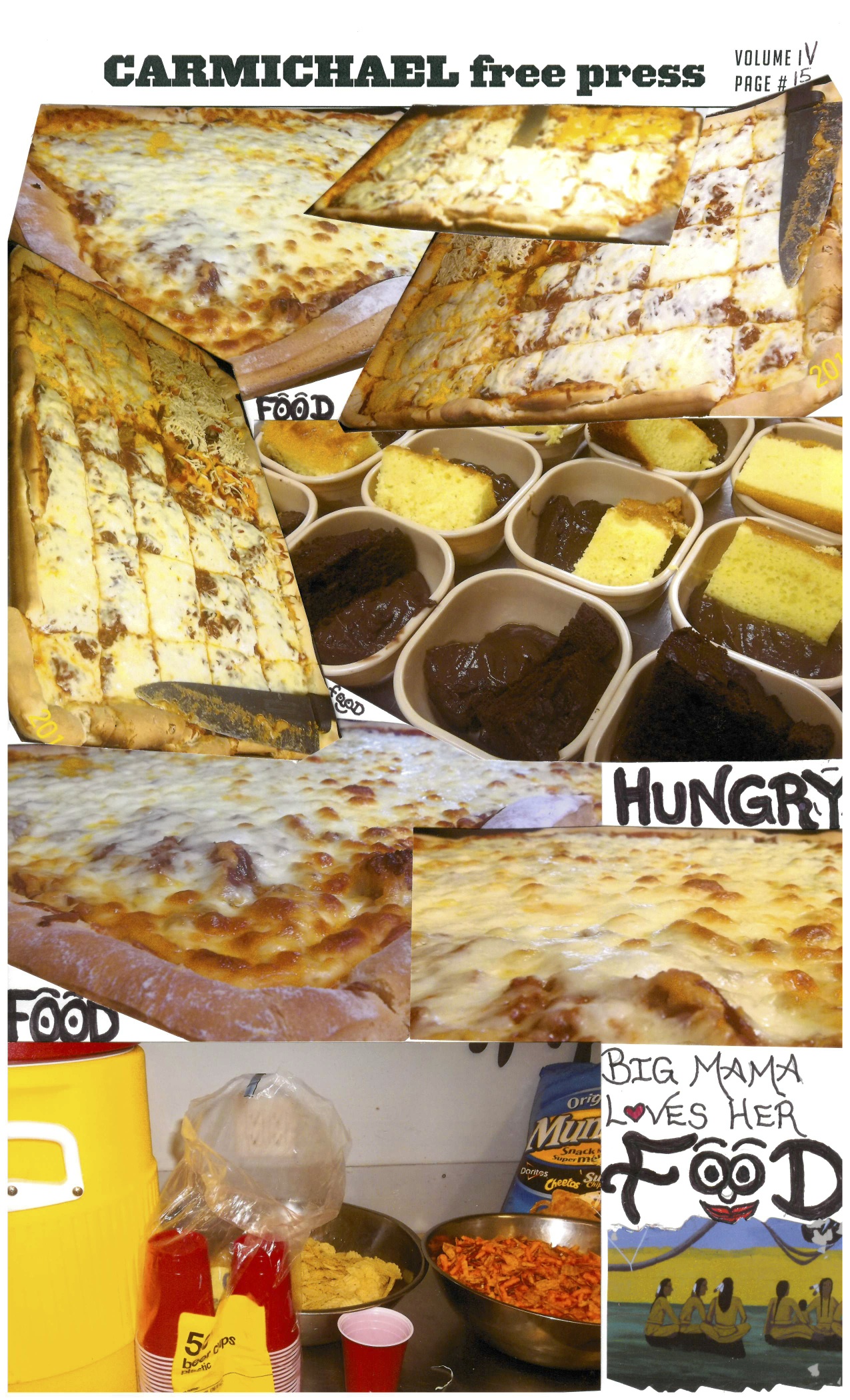
    Big Mama Page

    Every person has the right to have their voice heard, published, and distributed. People in your city are depressed, pissed off, a little bit high, lonely, in love, tired, dope-sick, or extremely happy, and they are entitled to these feelings. The power that is gained in sharing these feelings, putting them in some creative form, is invaluable. Outside of the online world of status updates and cartoon smiley faces, people need to have a forum to express themselves, and since Facebook and other online media aren’t accessible to those without internet access and aren’t really collective, the Free Press fills the void.

    Authors and artists work years to get things published or get their art hanging in a coffee shop in the over-marketed world of writing and art, but that doesn’t make the voice of the amateur any less important. If anything it makes it more significant; not being sold as a commodity or graded like a high school paper.

    The Carmichael Free Press is the perfect example of Carmichael programming—drop-in-style, no cost, inclusive to all, hilarious, frustrating, and motivating. Sober or not, published or not, practiced or not, community members can use the Carmichael Free Press as a home for personal expression, a place for injustices to be made public, love to be shared.

    The sign-off of our first edition reminds readers what the Free Press is trying to proclaim each and every edition—the importance of listening to and helping out people you have never met, and encouraging you to get to know them one way or another, possibly by participating in your local Free Press!

    “Sisters and Brothers, we are all on the same page. So don’t flip me!”

    Carmichael Free Press copy

  • HAT FARM

    Hat Farm

    HAT FARM on Instagram

    Since it’s invention, the ball cap has been the preeminent accessory of comfort and the ultimate casual lifestyle. People participating in baseball games or other leisure activities, those hiding from the harsh rays of the sun, those who don’t know how else to deal with a bad hair day, or those who don’t take themselves too seriously, wear hats. But they also wear hats simply because hats are comfortable.

    HAT FARM was born out of a desperate need for simple funds for the Carmichael Outreach Housing Program, and the regular classic hat donations received by the Clothing Depot Donation Program. Carmichael’s Housing Support Team works to remove the barriers the community has in finding adequate and safe housing, which often includes small financial obstacles that aren’t covered in other budget lines or in housing clients’ budgets. The profits made here will go towards removing those barriers and thus housing people, and keeping them housed.

     Teddy

    The hat I wear daily is one I’ve had since I was 12 years old, but only started wearing it about a decade ago. I have separation anxiety when I don’t have it for long periods of time. I have nearly lost it out the window of moving vehicles, in fist fights on the beach in Mexico, in severe gusts of prairie wind, in the rivers of Thailand, off ferries on the west coast. I’ve repaired the plastic snap three separate times, and the once body-filled hat now rests limp and tattered like a discarded pair of briefs. I have moments of panic knowing that one day it will disappear in a drunken stupor or traumatic event, some instance where losing your head and what rests upon it is possible. For that reason I began auditions for a new, future everyday hat. Like when your best friend moves away, you start flipping through your contact book dejectedly for someone that may be able to partially fill the void, if anything at least for a weekly beer.

    When I began hat auditions I happened to be working at Carmichael Outreach, a community drop-in centre downtown Regina with free food, coffee, hygiene products, housing services, needle exchange, and clothing, open to anyone in the city. Hundreds of clothing donations are dropped off to the back door weekly where they are sorted and put out for the community depending on their seasonal use and if there is room in the tiny three-rack clothing depot. Community members browse daily for clothes, dishes, puzzles, Patsy Cline CDs, used printers, children’s books, all of which are free in the clothing depot, open all day Monday to Friday. Closets from all over Saskatchewan have been cleaned out after decades of storage bringing in vintage Star Wars toys, unworn embroidered cowboy shirts, antique decorative plates, slightly malfuctioning DVD players, and much more.

    Larsen's

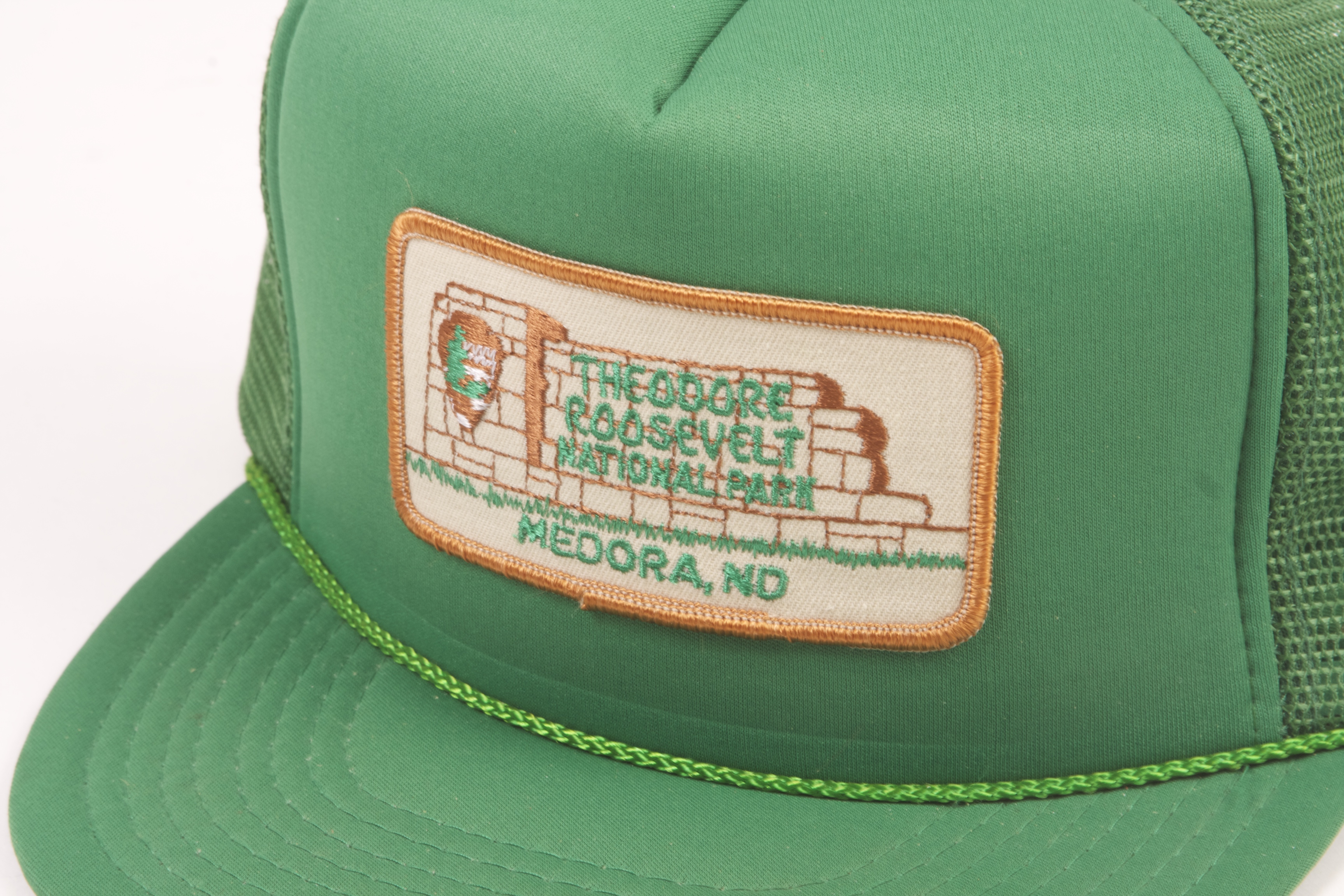
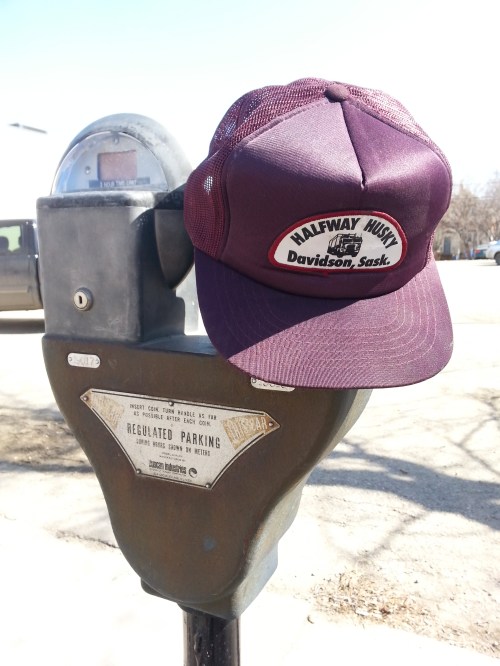
    One day I walked into the clothing depot to find a stack of hats six feet long, the collection of hat connoisseurs around the province. Farm industry logos, country legends, family vacation destinations, family reunions, all immortalized on the unparalleled medium of the trucker hat. Several small town hat collectors dropped off their decades-old work so that hatless men in the city could feel the dignity of cranial comfort once again. Before the hats were put on the rack, I searched through the most classic, mint condition, collectors hats from all over the world, and documented the rest which have all been put back into the clothing store.

    All proceeds from the hats collected and sold here will go towards the Carmichael Outreach Housing Program, including funds for damage deposits, carpet cleanings, new small household items, fees for money orders for rent payments or identification applications, or any other potential barriers that might keep community members from maintaining stable housing in the City of Regina. Because as much as a person needs a nice ball cap to feel comfortable, a roof over their head does them one better.

    For more information, to buy, or to donate, email thehatfarm@gmail.com

    Halfway Husky

  • Slow Code Colonialism

    The following essay was published in the Summer 2014 edition of Transition Magazine, a Canadian Mental Health Association publication. Digital copy available here.

    You are lying on the street in cardiac arrest. I am obliged to inform your unconscious, breathless body of my newly acquired First Aid training. This, for some reason, is supposed to reassure you, as if my knowledge to enter three digits on a phone grabbed out of a bystander’s pocket changes the fact that your heart has ceased. All I can do is Check, Call, Care, and call bystanders to action, but according to the brawny male firefighters who taught my First Aid course, this should be reassuring. The fewer bystanders, the better, they said. According to said firefighters, CPR and portable defibrillators are so effective that you—unconscious, vulnerable, responsibility of the provincial healthcare and social services systems—shouldn’t worry about what will happen if you don’t wake up, but rather, what will happen if you do.

    The day after I became First Aid certified, I heard a piece on public radio that spoke to the misconception of the effectiveness of CPR. When it comes to the point where a human is in cardiac arrest, known as a Code Blue, healthcare professionals are obligated to administer life-saving procedures. When doctors are confident that CPR will not save a life, or will greatly reduce the quality of life that remains, they will often fake it, for it “looks and feels like a really gruesome way to usher someone out of this world.”(1) They go through the motions of CPR without actually trying to save the life. They do it so the patient can die. Slow Code—they even have a name for it. When family and friends are watching a loved-one slip away, they cannot understand a doctor who would stand by idly and let their family member die. CPR, in this case, is a system for the conscience of the bystander, not for the person in emergency. The professionals do this because the system of resuscitation is flawed.

    A friend was recently in the hospital. He got into a fight with three men half his age, he told me. Others claim that while inebriated, he tripped, the side of his head the first part of his body that struck the ground. Skull fracture and brain swelling which led to brain damage and memory loss. I visited him regularly—I sat there as an idle bystander contributing to his deteriorating health by supplying him with cigarettes which he forgot he had, as he basked in the overwhelming nature of his life of abuse and addiction. We played cards as he mumbled through the imagined traumatic experience of being locked in a house with three family members who beat him until he bled from the ears.

    When my friend is discharged, he will leave the hospital to no home and to a family who can no longer give him the support he requires. The hospital can’t keep him forever. The rehabilitation centre says he is too high-functioning—a man who cannot remember where he put his paintbrush or the names of his brothers. The province cares not for the marginalized. An ethically responsible governing body cares for the vulnerable, but my friend will end up homeless in a week, one inevitable head injury away from complete debilitation. He has never met his social worker. The social worker in his ward blankly stated that it isn’t her problem once he is discharged. The workers search on their computers and make phone calls in vain, aiming to satisfy the bystanders, knowing that whatever they do, it won’t save his life, because, whether or not they know it, the system of resuscitation is flawed. To those within the social welfare system, this is the most receptive the state will ever be—just another case file in the colonial shell game that is the Canadian welfare state.

    Those who have not dealt with the system imagine that it works for all. They imagine that the cracks through which people slip are fairy tales told from faraway lands. They can’t imagine a circumstance where someone would be left out in the cold after a traumatic event, because, they think, this is Canada, land of universal healthcare and equal aid for all. This liberal notion of equality of opportunity fails to understand the systemic racism which is fundamental to the colonial state. The gaps exist on purpose. The system of resuscitation is intentionally flawed—it is designed to appease the conscience of the bystander. But unlike a medical Slow Code, it is flawed in its design to take resources and power out from the trained field workers through lack of programs that offer proper supports. Fifty-percent of the Saskatchewan provincial budget is devoted to healthcare and social services, totalling over $5.5 billion per year.(2) With such a significant portion of the provincial budget devoted to two departments of human services, the general populace can only assume that the dollars are sufficient and effective; however, gaps in the departments are purposeful and widespread.

    Aboriginal communities have been stunted by the implementation of provincial and federal social assistance programs, contributing “to the persistence of individual and community economic dependency.”(3) These programs run on outdated living allowances, low earning allowances making a transition to employment impossible, and lack of adequate supports for Aboriginal people living in urban centres or dealing with HIV/AIDS. These programs run on cycles of poverty and death. A growing number of Aboriginal people have been forced from reserves to urban centres, where it is exceedingly difficult to live as a traditional Aboriginal person. It is a direct extension of settler colonialism, originally performed under the mandate of pre-confederation’s Indian Affairs, whose policies to ‘civilize’ Aboriginal populations introduced the residential school system. Residential schools were decentralized into the provincially-run Ministry of Social Services, a ministry which continues to perpetuate the same exterminatory mandate. Slow Code Colonialism—neocolonial institutions created to emphasize the desires of the bystander and ignore the needs of the sick. Neocolonialism is already the disguise for cultural eradication and is further masked as the unavailability of programs due to lack of financial support. Where supports exist, resources do not. My friend qualifies for a bed in a home for those with Acquired Brain Injury, but only after sifting through a waiting list of several months, and not if he continues to battle his addiction. Fairytale cracks become real. The ministry that originally took responsibility for my friend as a young boy sent to a residential school, now waives this responsibility and deliberately leaves him to flop around on shore, their program near completion.

    I was taught to Check, Call, Care. As your consciousness flickers, as shock sets in, I brush your hair from your forehead and tell you it will be alright. I lean close to your face to check your respiration. You are not breathing. Since I do not have my recommended mouth-cover, I begin compression-only CPR. I tell a bystander to call for help. I break your ribs and bounce up and down on your sternum with my arms locked at the elbows. The paramedics arrive. They are trained in emergency and begin Slow Code CPR, feigning an attempt at revival because that is what bystanders expect of them. There’s nothing we could do, they say, but I am appeased because of their valiant attempts at resuscitation. What they don’t tell me is that they were thinking about football when they were supposed to be pumping blood through your chest. You somehow survive despite the Slow Code, but you wake up with broken ribs, brain damage and you are expected to survive when you have no place to live and no family to care for you. And the system of resuscitation wins in its purposeful defectiveness.

    “Sir John A. MacDonald’s policy of starving First Nations to death in order to make way for the western expansion of European settlers,” along with the residential school system, “meets the criteria of genocide…by omission, if not by deliberate commission,” says a letter to United Nations Rapporteur for Indigenous People.(4) The policy of nineteenth-century Canada differs from today’s policy of intentionally defective programs of social service only in thin veils of supposed goodwill. There is no greater place to hide genocidal policy than behind a department of human services. The only other difference between Canada’s previous policies of starvation and the policy of today is the time elapsed in which the extent of the genocide could be fully understood. And time will again pass.

    The only way to stop Slow Code Colonialism is through a remodel of the system of resuscitation. The Ministry of Social Services is just one of the administrative programs that force subjugation by stamping out hope and dignity through “a complex web of city agencies and institutions that [regard] the poor as vermin,” Chris Hedges explains.(5) These programs work together to perpetuate the accepted state ideology by operating under the guise of being a protective force. The police who mine for crime by making arrests in communities of lower economic status work as the frontline of the repressive arms of the state. The military who break up blockades of First Nations fighting for liberation form another wing of Slow Code Colonialism. These structures work to protect the status and wealth of white middle class Canada, while ensuring the poor Aboriginal populations live in abject poverty, utterly subordinate to those who control the state. These structures project an image, and behind this image is a bloated bureaucracy focused not on remedying social evils, but on keeping these injustices out of the field of vision of polite society.

    The system must be remodelled to one that does not look to appease the taxpayer, but rather to adequately serve the marginalized. This starts when bystanders become involved and demand that governments stop these hegemonic structures of administrative programs such as Social Assistance, the judicial system, the police and RCMP, and unregulated resource development that make up the branches of colonization. This will dismantle the less visible forms of  “a very active system of settler colonialism.”(6) It starts with education and partnership that leads to real reconciliation “grounded in political resurgence” that “support[s] the regeneration of Indigenous languages, oral cultures, and traditions of governance.”(7) The system will be reformed when the programs intended to assist people do just that, instead of control, institutionalize, and cripple. As with any cooperative and proactive social system or community network, a welfare system administered by those to whom it caters is a democratizing step to reconciliation and empowerment. Aboriginal participation in the development of such strategies and programs is necessary to eventually eliminate the economic gap.(8) These state apparatuses will require more than just reform to make them democratic, but will require revolutionary change encouraged by grassroots movements like protests at Elsipogtog and Idle No More.

    First Aid isn’t as futile as it may have seemed at first. Although I still tread in the overwhelming nature of ignorance of how to respond to an emergency more serious than hunger pangs, I at least know that the symptoms for stroke, diabetic shock, and extreme inebriation are identical. I now know that the systems they taught me are evolving and changing because their legitimacy is still highly in question. I am no longer a bystander, but a person of direct action. The fewer bystanders, the better, they told me. With fewer bystanders, Slow Code Colonialism can shift to a more balanced paradigm of moral care for all.


    1. Goldman, Dr. B, (writer). Goodes, Jeff, (producer). 2013. “Slow Code.” White Coat, Black Art. CBC Radio 1. (http://www.cbc.ca/whitecoat/2013/10/18/slow-code/)

    2.  Saskatchewan Provincial Budget Summary, Ken Krawetz Minister of Finance, Government of Saskatchewan, 2013-14 GRF Expense, p44. (http://www.finance.gov.sk.ca/budget2013-14/2013-14BudgetSummary.pdf)

    3. Report of the Royal Commission on Aboriginal People. 1996. Ottawa, Indian and Northern Affairs Canada. Volume 2, Part 1, Chapter 5, Section 2.9 (http://www.collectionscanada.gc.ca/webarchives/20071211061313/http://www.ainc-inac.gc.ca/ch/rcap/sg/sh88_e.html)

    4. Fontaine, Phil. Farber, Bernie. 2013. “What Canada committed against First Nations was genocide. The UN should recognize it.” The Globe and Mail. October 14. (http://www.theglobeandmail.com/globe-debate/what-canada-committed-against-first-nations-was-genocide-the-un-should-recognize-it/article14853747/)

    5. Hedges, Chris. 2005. Losing Moses on the Freeway. New York, NY: Free Press, Chapter 1, p17

    6. Simpson, Leanne. 2013. “Elsipogtog Everywhere.” October 20. Retrieved October 21, 2005 (leannesimpson.ca/2013/10/20/elsipogtog-everywhere/)

    7. Simpson, Leanne. 2011. Dancing On Our Turtles Back. Winnipeg, MB: Arbeiter Ring Publishing, Back cover

    8. Painter, Marv. Lendsey, Kelly. Howe, Eric. 2000. “Managing Saskatchewan’s Expanding Aboriginal Economic Gap.” The Journal of Aboriginal Economic Development. Volume 1, Number 2, p42
  • The Adirondack Haystack Still Tours

    The Adirondack Haystack Still Tours Mini Book Tour/Camping Trip

    July 12 – Kokopelli Salon w/ Son Howler, 2052 Commercial Dr, Vancouver BC, 8pm
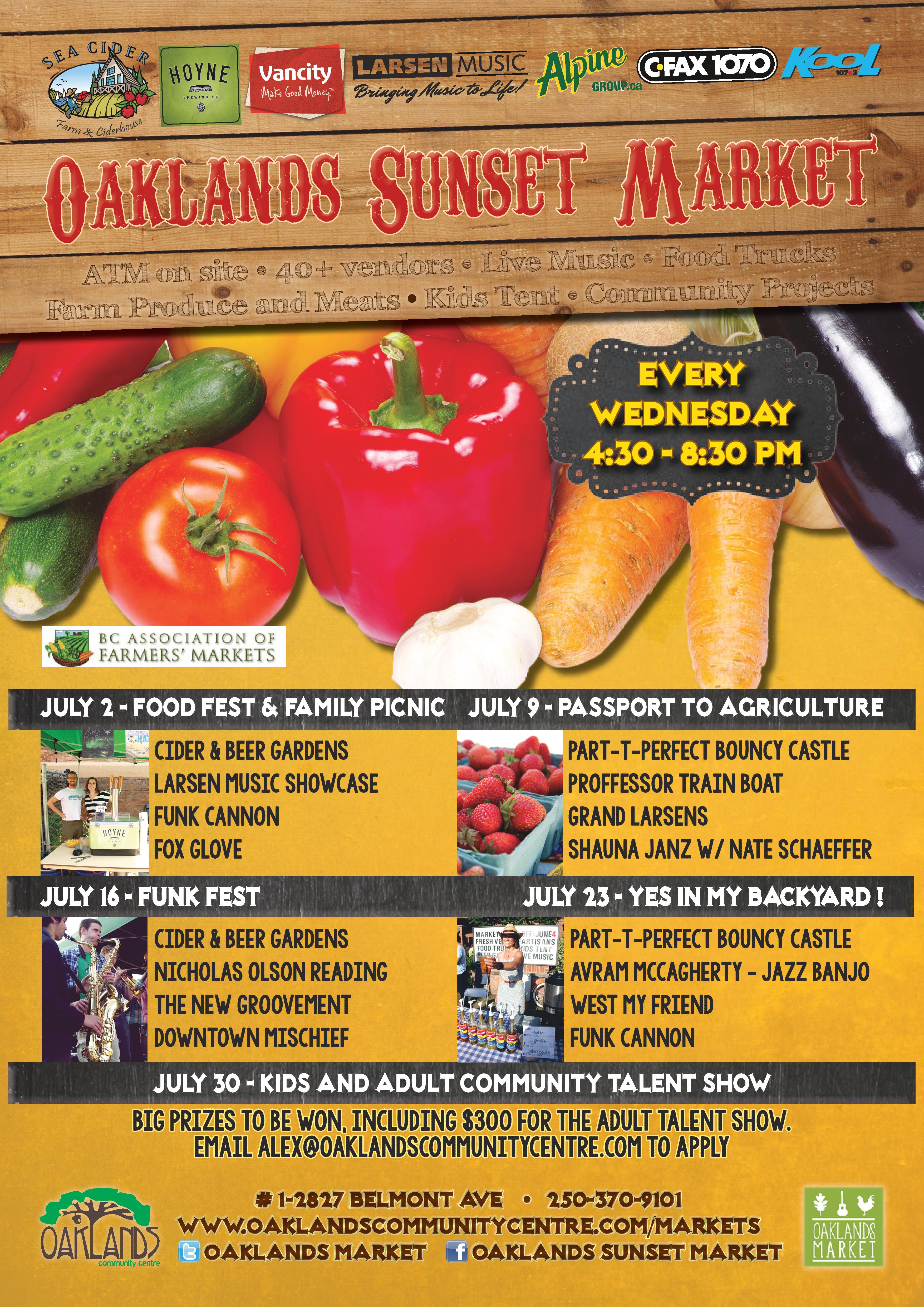
    July 16 – Oaklands Sunset Market, 1-2827 Belmont Ave, Victoria BC, 4pm
    July 18 – Pages Books, 1135 Kensington Road NW, Calgary AB, 7:30pm

    See posters below. Click below for PDF versions.

     The Adirondack Haystack Still Tours The Adirondack Haystack Still Tours Poster

    Market July-page-001

    July 16 – Victoria

  • World Crokinole Championships – The Great Paternal Experiment

    The following piece was featured on Ominocity.com out of Saskatoon, Saskatchewan.

    Crokinole 4

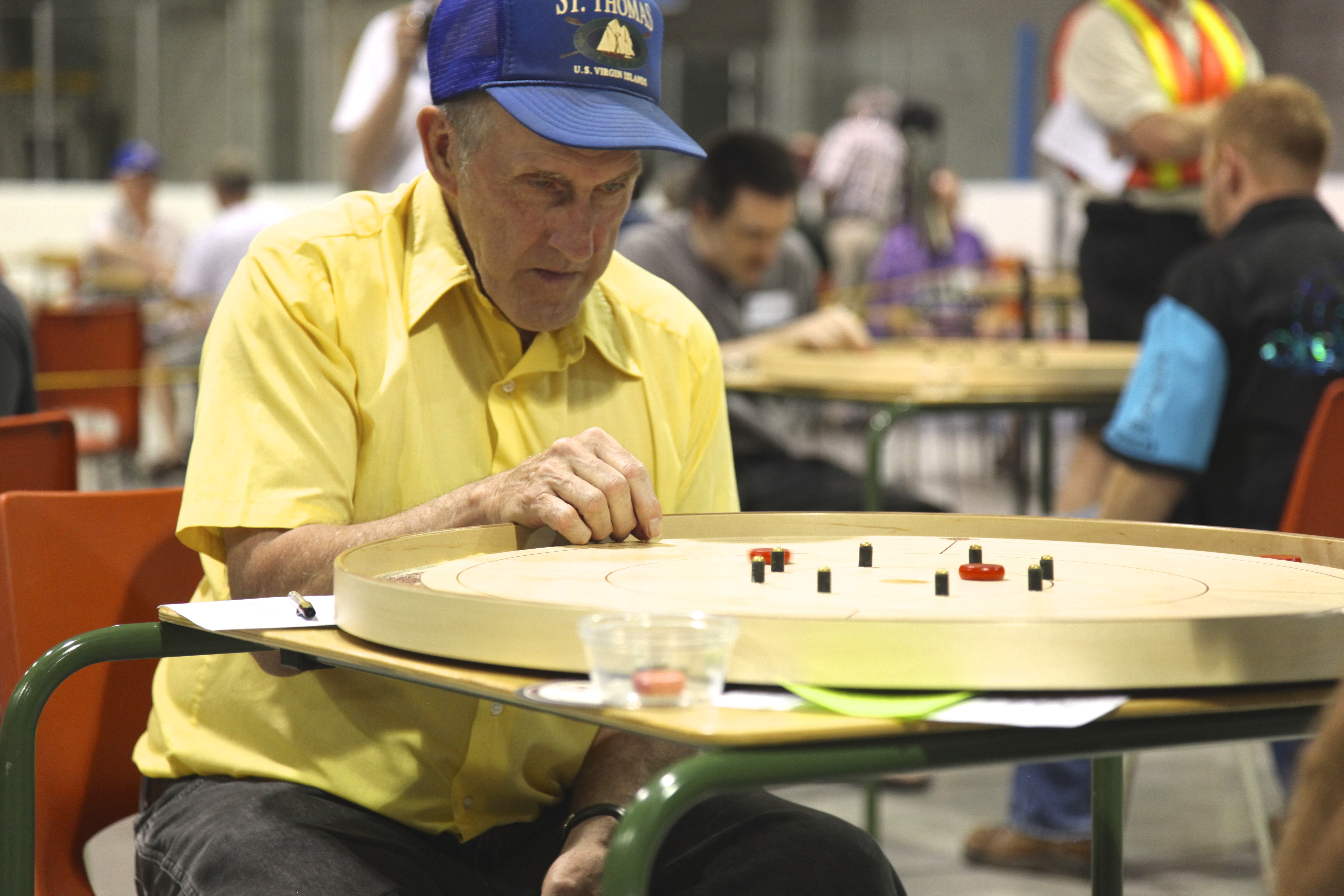
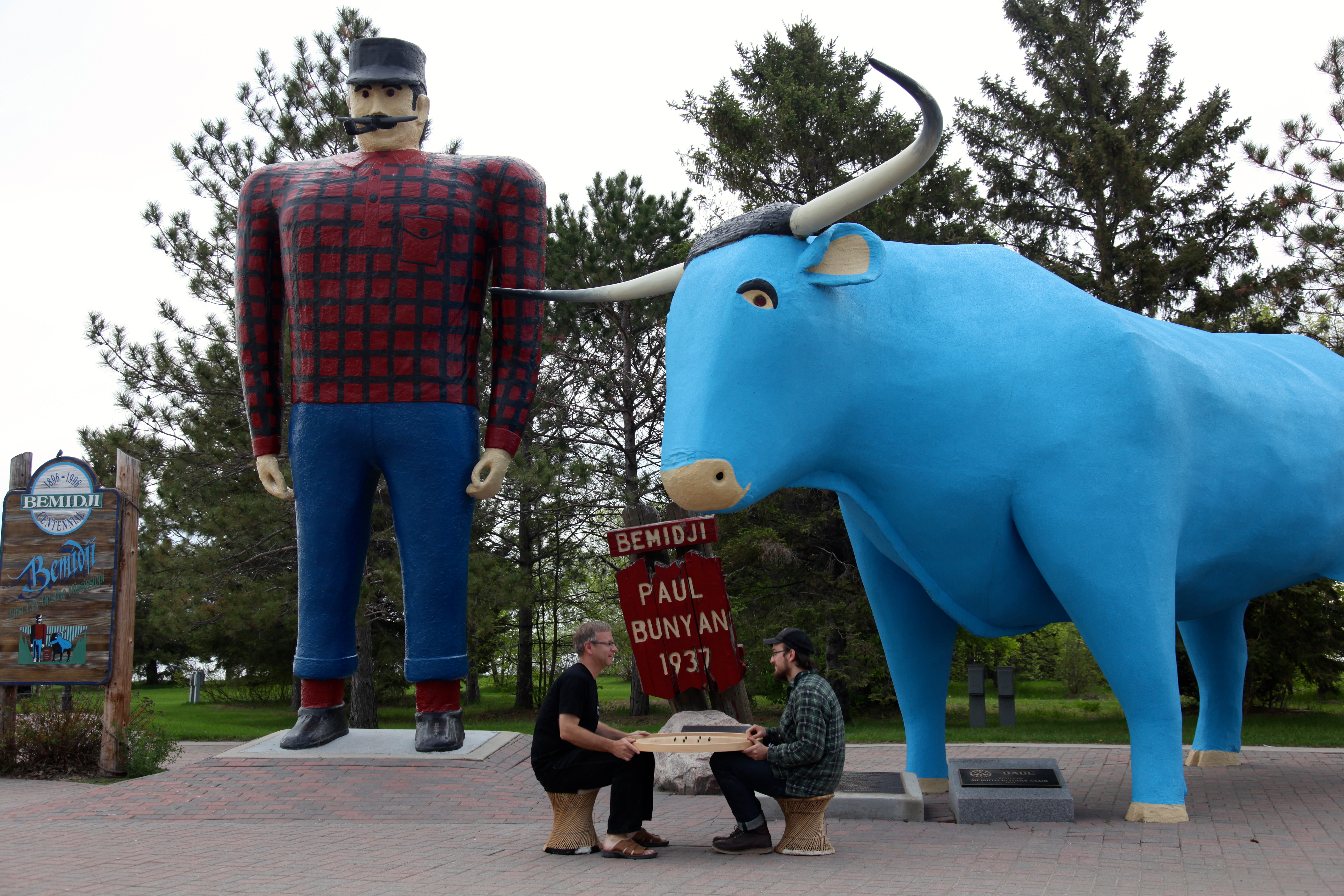
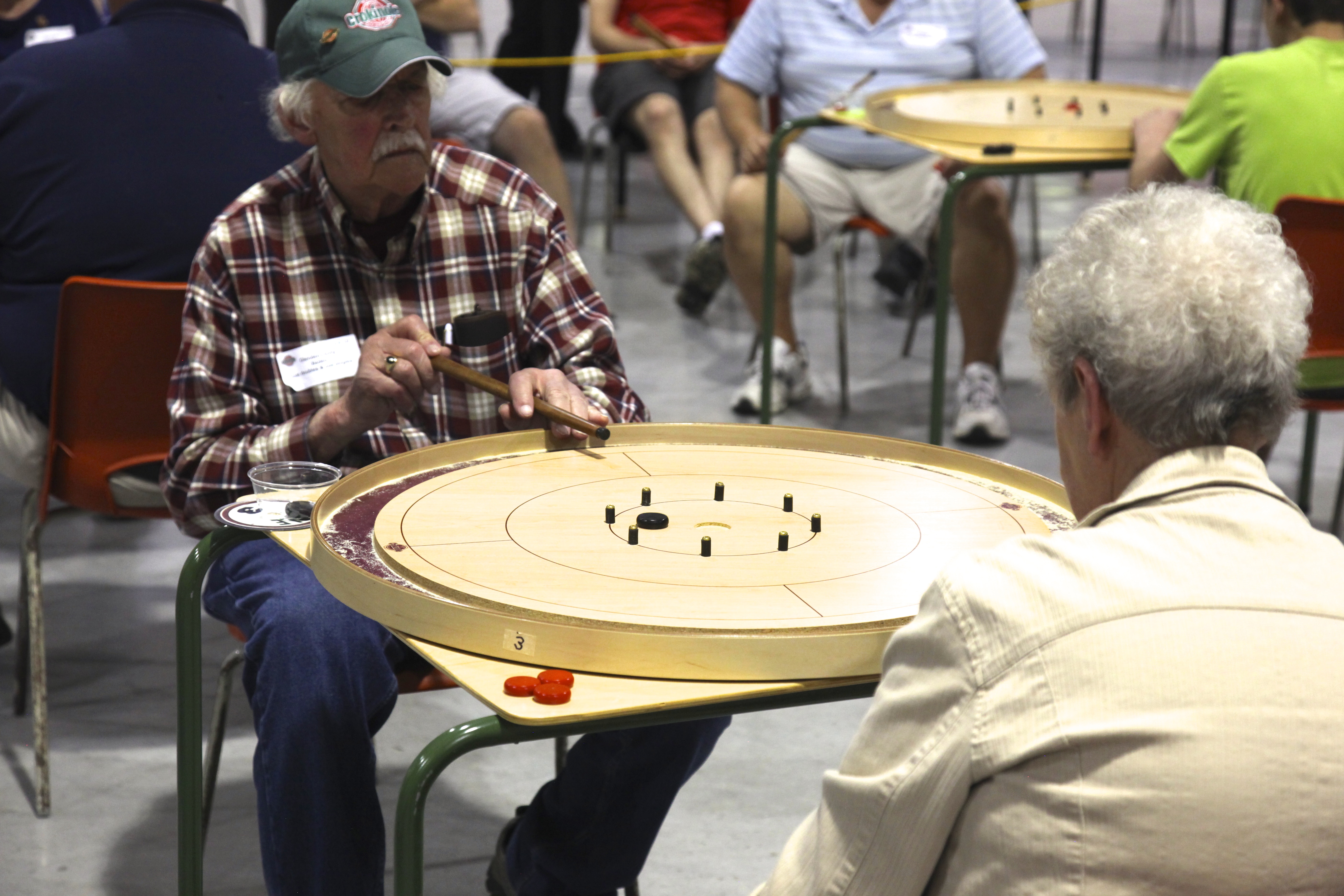
    If you’ve never heard of crokinole, you’re likely not a citizen of the disintegrating Canadian countryside. If you are from the North of 49 and you still haven’t heard of crokinole, you either a) are from a city, b) didn’t grow up in a church, c) grew up with a Nintendo, or d) had unloving parents. Crokinole is a two or four person game played on a 66cm-diameter circular board, in which each player has a determined number of discs made of lathed wood. Each player purposefully flicks these buttons with a finger or wooden cue towards a hole in the centre of the board a quarter-of-an-inch deep and only slightly larger than the button itself, attempting to avoid the eight stationary pegs that guard it like pawns on a chess board.

    It is a game you may have played with your loud uncle and your wrinkly aunt before Christmas dinner. A game in which your grandpa is likely indomitable in between heavy naps in a dusty cardigan on an itchy couch. It is a game you may have tinkered with not knowing the rules (of which there are perhaps three), or, as previously determined, a game you may not have ever even heard of. For myself and my father, it is the game in which we competed at the World Championship in Tavistock, Ontario on June 1, 2013. The World Crokinole Championship, widely revered as the Stanley Cup of crokinole tournaments, the Kentucky Derby of the forefinger stallions, centre stage of peculiar rural males aged 39-88, was obscurity and sportsmanship perfectly defined.

    Crokinole 3

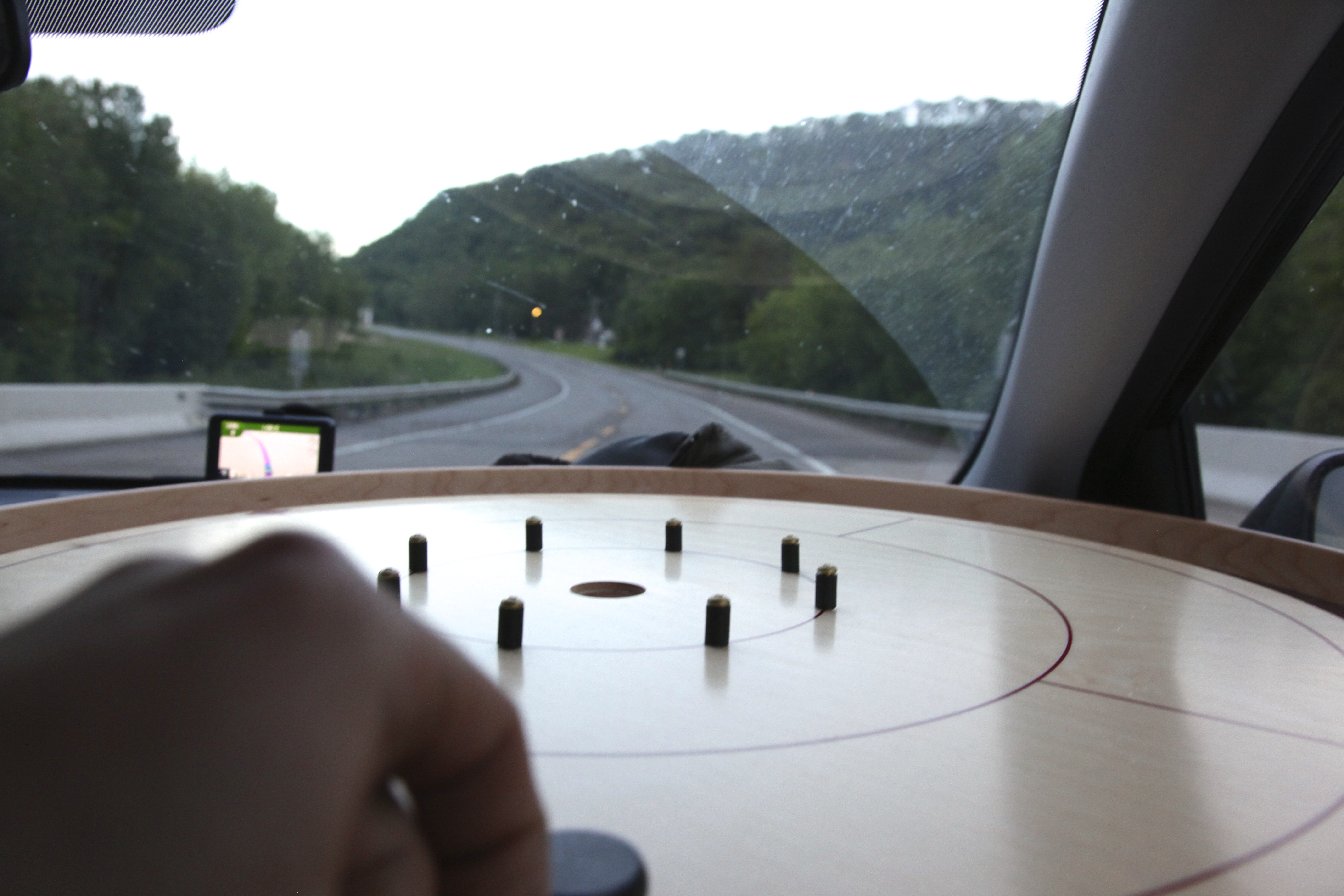
    After driving straight through six U.S. states and two Canadian provinces, we pulled into Tavistock, home of the oldest known crokinole board dating back to 1876. During the drive, when our periods of silence (often reaching four or five hours at a time) were broken, we discussed religion in many contexts; traditional theology, silage and dairy production in devout farming lives, and most importantly, righteousness through crokinole techniques. We made our ecclesiastical pilgrimage, fasting from sleep and whole foods in the goal of reuniting westerly disciples with the holy land of immaculate wooden conception. We were pilgrims for the board of life. The home of crokinole was like I had dreamed it would be as a kid of twenty-four years old. An established farming community of dairy producers with a Main Street that boasted a two-decade old Chinese Restaurant, local credit union, and butcher shop. As one might expect, side streets were dotted with various forms of seniors’ homes.

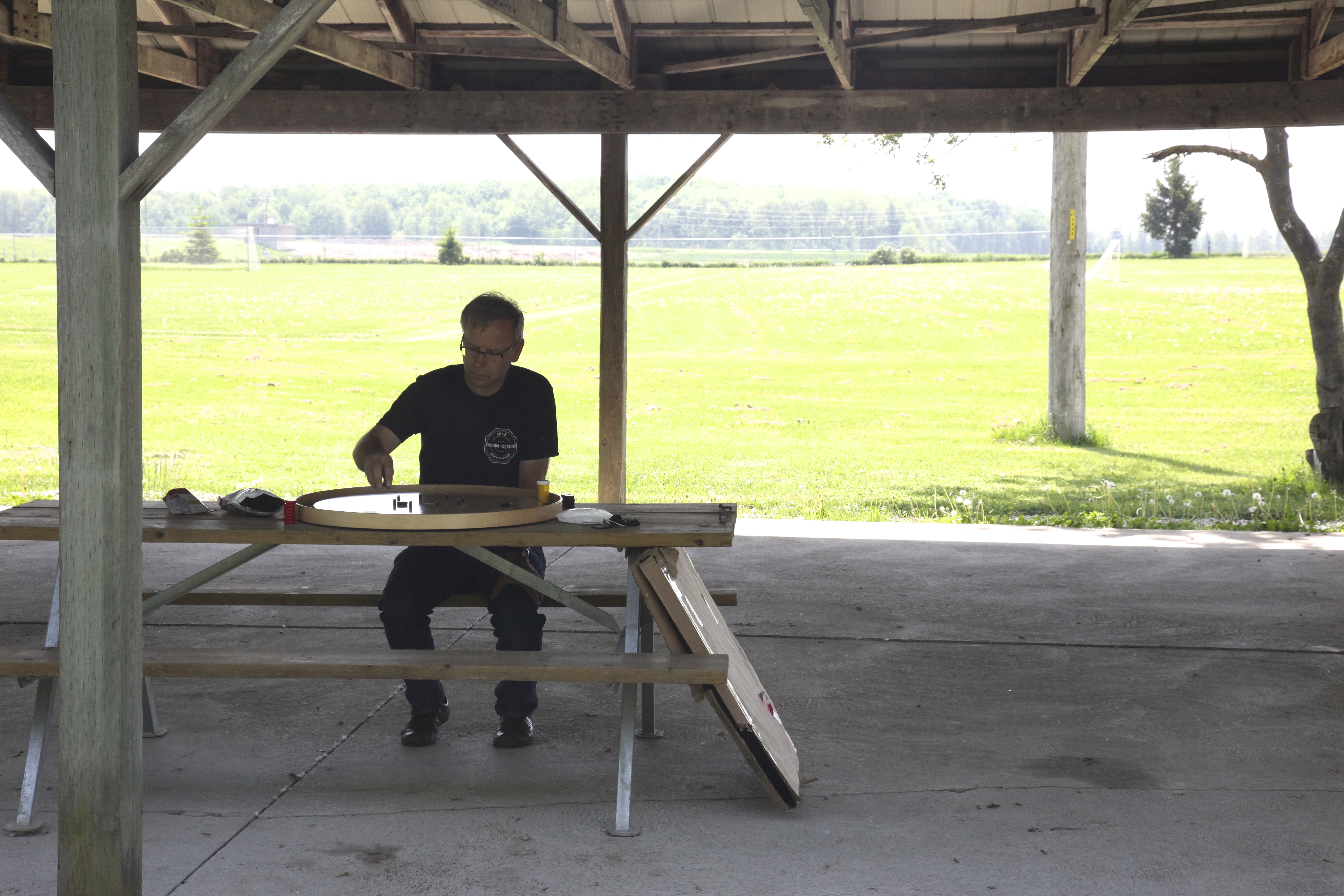
    Upon arrival, silence was broken by John Schultz, the bald, wiry, extremely pleasant chairman of the World Croknole Championship, asking, “Are you folks here for the crokinole tournament?” He woke us napping in the park—our first hours of horizontal sleep in two days—and it finally occurred to me what we’d done. We drove twenty-two hours for crokinole. In the same amount of time I could’ve driven to the flawless forests of northern California. I could’ve driven to Nunavut. “Holy shit,” I thought, “I could’ve just travelled an hour and played a game of crokinole with my grandpa.” But instead I drove twenty-two hours to play with all of the grandpas of southern Ontario. John Schultz continued to tell us that other folks drove in from Michigan, New York, Ohio, P.E.I.. We cleaned up, grabbed our board, and began our pre-tournament practice on a picnic table in the shade of Queens Park.

    Crokinole 2

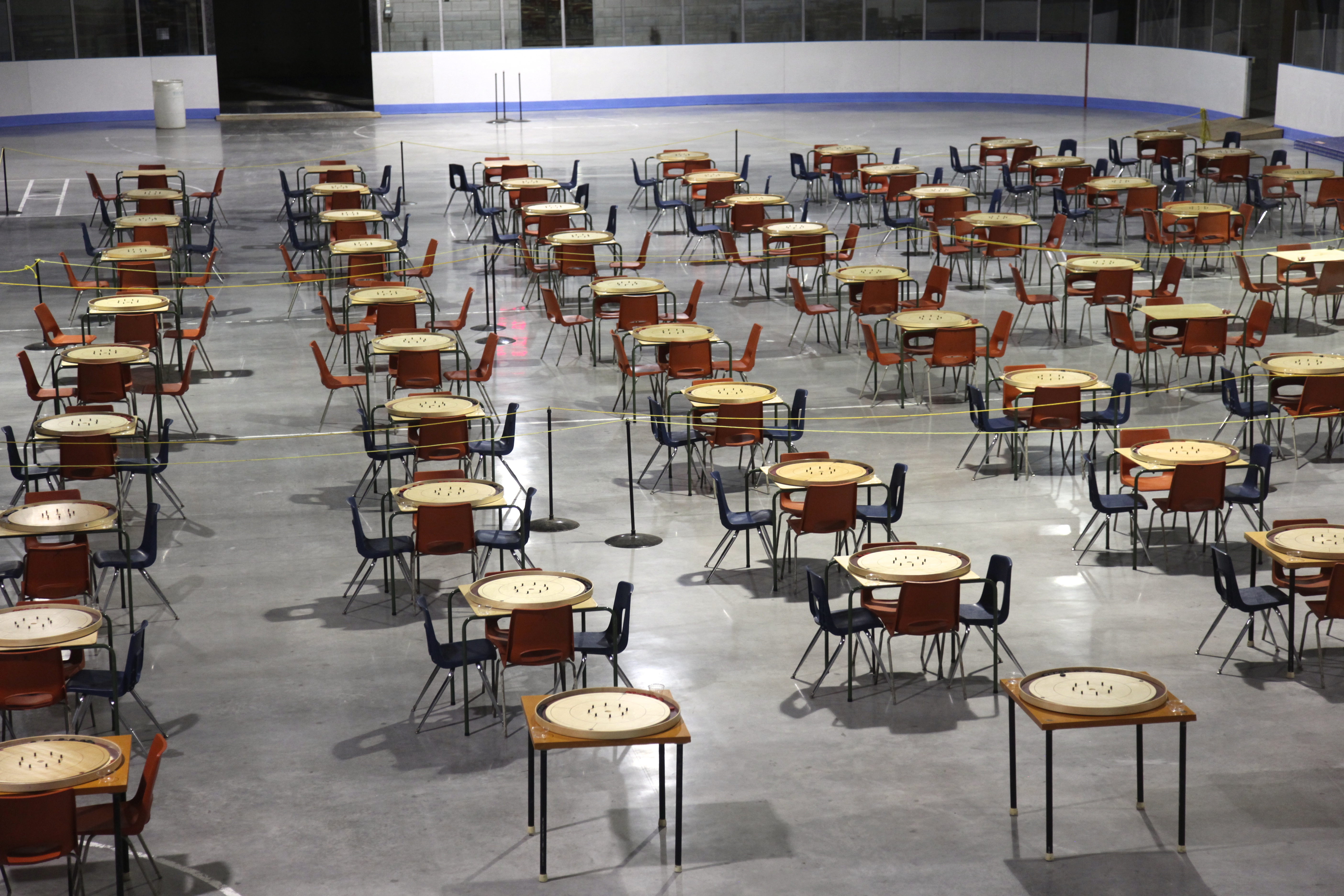
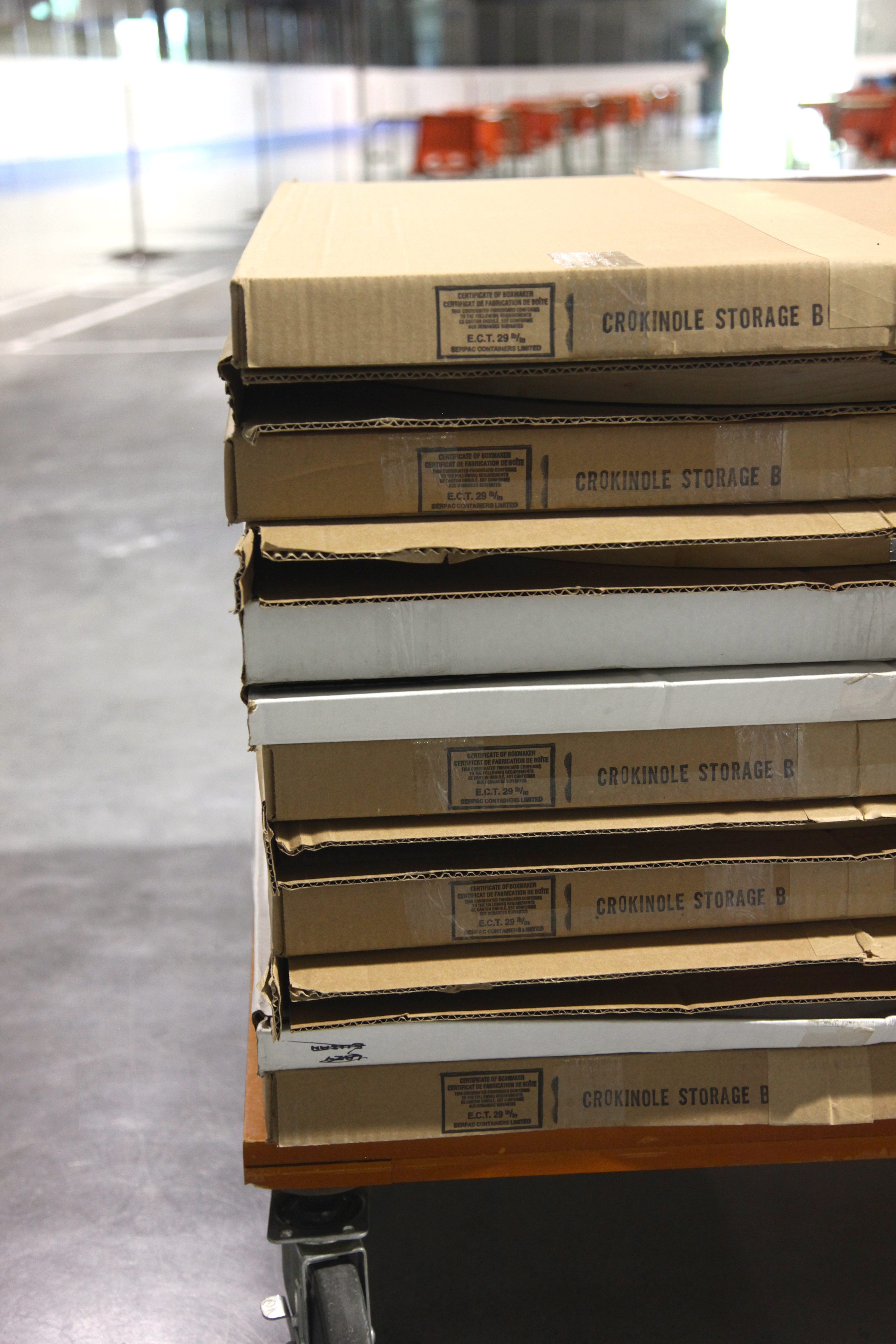
    On Saturday morning when I woke up at dawn to practice before competition began at 8:30, the Ontario air was thick. The humidity weighed down the crokinole buttons as if Mother Nature rubbed each one on her sweaty chest. After a breakfast fine-tuned for finger endurance I followed my father into the arena which housed over 64 freshly waxed, previously untouched boards set up in a grid on the concrete slab of the dried up hockey ice, all partitioned by yellow rope. Competitors and spectators in jean shorts and agriculturally branded caps floated around the merchandise on the perimeter of the rink. Those keen on capitalizing on the lucrative crokinole market sold World Championship t-shirts, ballcaps, boards and board accessories. People competed in the skill shot competition and captured photos of the trophies which were handmade for the event (it is difficult to find a golden plastic figurine of a man playing crokinole to fix to the top of a regular trophy). When tournament competition began, over 280 competitors showed their masterly applied-geometry skills and muscle memory. Each competitor sat down at a table with ten strangers for eight minutes at a time until the horn sounded, shaking hands and wishing luck to people they hoped to blank eight points to zero. Saturated in Canadian politeness, if crokinole isn’t a game of true sportsmanship, it isn’t anything at all.

    Crokinole

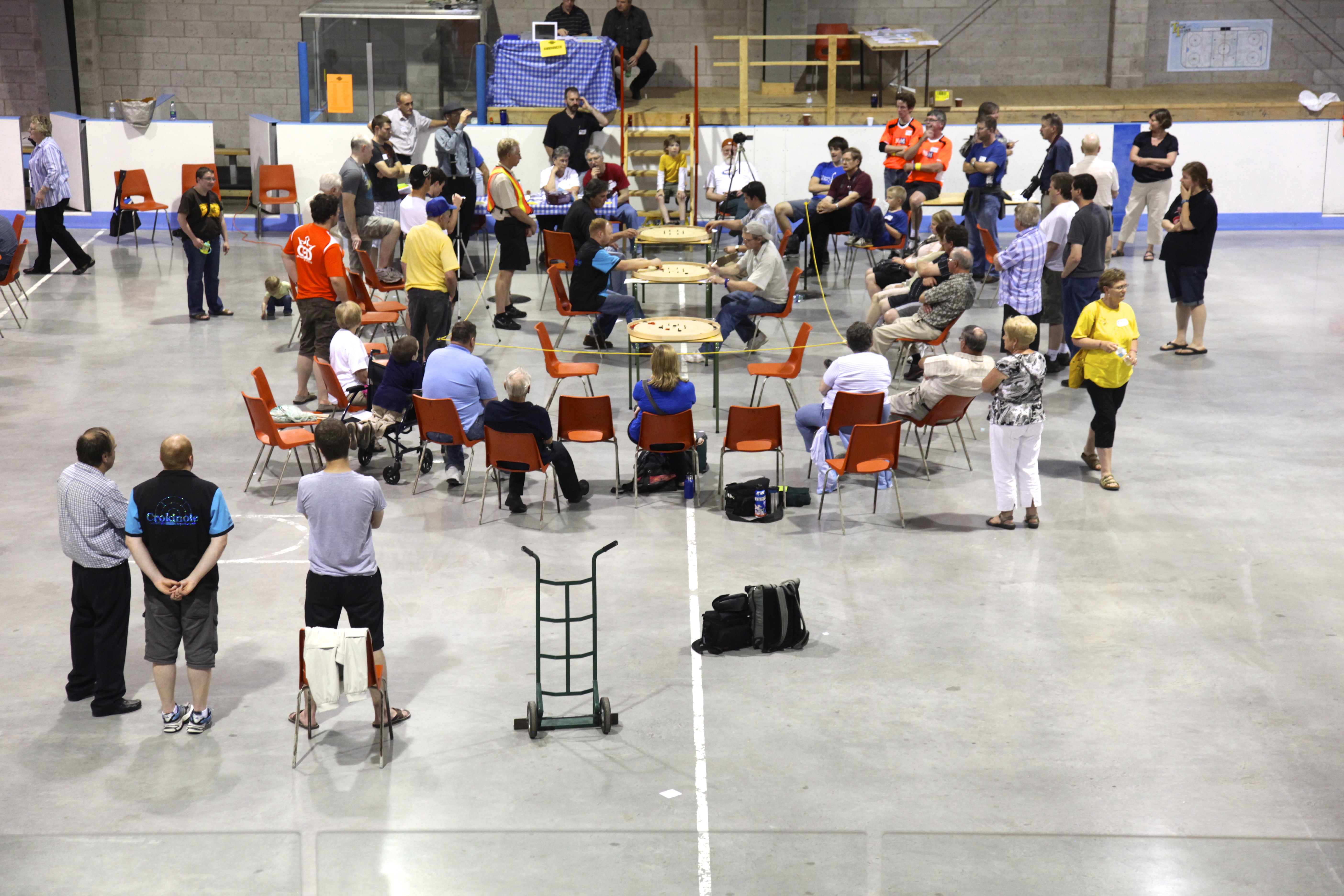
    As for the competition, unfortunately the prophesy from aged-competitor Dave Skipper that, “people with beards and moustaches shoot better on these boards,” didn’t prove true. I, one of the few participants with a gnarly beard, didn’t even place in the top half of the draw, and the eventual singles champion, John Conrad, had the hairless face of a teenager, although he was surely approaching his golden years. My father proved to be worthy competition, scaling the ranks of eleventh of 86 participants in the main draw, making the playoff round with the true elites. The final match drew crowds upwards of forty, those who had already sweat through their crokinole team jerseys and sweat bands, groaning and whispering with the final shots of the game. Hands become shaky with such pressure. For one of his final shots, Conrad made an incredible triple take-out. Someone in the crowd said in praise, “I think that was a statement.” In the finals, fathers sat behind the yellow rope, watching sons in competition, offering familial support. My father and I participated in the great paternal experiment that is crokinole.

    While discussing board consistency during the final round, a man who placed third in the doubles category, making no excuses, commented: “The heat, the humidity—we have been battling the elements all day long,” as though it were an Ironman competition, which, in a way it was. The oldest participant was 88-years old, and was celebrating his 50th wedding anniversary at the tournament. He had competed in all previous fifteen World Championships that had been held.

    If it were a televised event, and if the champions were interviewed and asked to describe their feelings, I imagine that like any other world final, they would stumble and mumble in speechlessness. There is no way to properly explain a world championship of any sport, and it only becomes more grueling when it is a celebration of nearly-perfected obscurity. We travelled knowing full-well that we were participating in an antiquated parlour game that itself was competing against screen-bright technologies for space in the family room. What we didn’t know was that our hands would shake and that we would miss shots from fried nerves in a game usually as relaxing as a free massage. We didn’t know that we’d have to practice for another year to make even a dent in the crokinole kingdom.

    Back to the grind. Back to the board.


    Crokinole 1

    Crokinole, The Finals

    Crokinole Boxes

    Crokinole Cues